Friday, 10 February 2017

Papias, Irenaeus and the Gospels.

1 Introduction
Papias' writing dates from about 100 years after Jesus died. Unfortunately, what he actually wrote has not survived. All we have are quotations in other works which refer to his "Expositions of the Sayings of the Lord" which is allegedly a collection of things Papias heard said by the companions of elders who claimed to have known the first disciples.  We can illustrate the chain of information  thus:

Jesus  → Apostles → Elders → Companions of the elders → Papias → Writings which reference Papias → Us 


Basically, we are getting 5th hand information. 


So Papias is not a direct witness to what the apostles of Jesus were saying (far from it).  That is an important point because it is claimed by some Apologists that the so-called "testimony" Papias provides is evidence that the second Gospel of the NT was written by Mark, the companion of Peter, and that the first Gospel was written by Matthew, the disciple of Jesus.  If these claims were true, they would be highly significant. (See 2 and 3 below).


The main problem with Papias however is that he provides information that no one believes - not even Christian Apologists. He wrote about alleged sayings of Jesus that no one believes Jesus said and he gives an account of Judas' death that no one believes.  (See 4 below).


So, Apologists will believe that Papias is reliable about some things (e.g. about Matthew and Mark) even though his writings are not reliable, because they want some of what he says to be true. When Papias tells them something they don’t want to hear,  they choose not to believe him.   Credulity has taken precedence over scholarship.   


2 Papias on Matthew

According to the 4th century historian Eusebius:

And this is what [Papias] says about Matthew: “And so Matthew composed the sayings in the Hebrew tongue, and each one interpreted them to the best of his ability.”


The two issues here are (a) the Gospel of Matthew in our Bibles is not just a collection of the sayings of Jesus, and (b) it was not written in Hebrew.  The gospel of Matthew must have been written in Greek because Mark’s Gospel was the source for the Gospels of Matthew and Luke and we know  Mark was originally written in Greek.  The Gospels of Matthew and Luke must have used a Greek source because in many places they agree precisely, word-for-word, with the Gospel for Mark in the Greek.  Also, the Gospels of Matthew and Luke agree with passages that have come from the "Q" source, which was originally written in Greek.


So Papias is either referring to a different document or if he is referring to "our" Gospel of Matthew, then he doesn't know what he's talking about and is being just as reliable as he was when he said that Judas Iscariot’s head bloated up so much that it would not fit into a street that a wagon could easily pass through.


3 Papias on Mark

The other of Papias’s comments refers to Mark.  If he’s not talking about our Matthew, is he talking about our Mark?  Here’s what he is reported to have said...


When Mark was the interpreter [Or: translator] of Peter, he wrote down accurately everything that he recalled of the Lord’s words and deeds  — but not in order.  For he neither heard the Lord nor accompanied him; but later, as I indicated, he accompanied Peter, who used to adapt his teachings for the needs at hand, not arranging, as it were, an orderly composition of the Lord’s sayings.  And so Mark did nothing wrong by writing some of the matters as he remembered them.  For he was intent on just one purpose: to leave out nothing that he heard or to include any falsehood among them.

One could imagine that Papias here is indeed talking about "our" Mark; if so, he’s defending it against charges that it is "not an orderly composition".  Something here simply cannot be true.  If Mark's intention was “to leave out nothing that he heard” in all of his time with Peter, that can’t be said of "our" Gospel of Mark which is actually quite sparse. If Mark spent all those years with Peter there would be a lot more material about Jesus. 


So maybe Papias is referring to a different Gospel and later storytellers latched onto his claim and suggested that what is now the second Gospel was the one he was referring to.  Or he is referring to "our" Gospel of Mark and is giving a false version of how it came to be.  In any case, there are no scholars who believe that Mark’s Gospel is a Greek transcript of Peter’s Aramaic preaching.  mark's Gospel is a Greek composition that records oral traditions which had been circulating for decades.


So to summarise: Papias does not provide reliable evidence concerning who wrote the Gospels.  He never mentions Luke or John, or if he did, Eusebius doesn't mention it. Therefore, the first assignment of author's names to Gospels is the comment made by Irenaeus in 180 AD.   Prior to that, the Gospels were circulating anonymously.


4 Papias on Jesus
Papers gives two traditions connected with the Gospel accounts of Jesus and no one considers these to be realistic. The first is an alleged saying Jesus: 

Thus the elders who saw John, the disciple of the Lord, remembered hearing him say how the Lord used to teach about those times, saying: "The days are coming when vines will come forth, each with ten thousand boughs; and on a single bough will be ten thousand branches.  

And indeed, on a single branch will be ten thousand shoots and on every shoot ten thousand clusters; and in every cluster will be ten thousand grapes, and every grape, when pressed, will yield twenty-five measures of wine. And when any of the saints grabs hold of a cluster, another will cry out, ‘I am better, take me; bless the Lord through me.’  


So too a grain of wheat will produce ten thousand heads and every head will have ten thousand grains and every grain will yield ten pounds of pure, exceptionally fine flour.  So too the remaining fruits and seeds and vegetation will produce in similar proportions. And all the animals who eat this food drawn from the earth will come to be at peace and harmony with one another, yielding in complete submission to humans.”


It's an interesting claim but no one thinks Jesus taught it.  Therefore, Papias’s sources for the words of Jesus are unreliable, to say the least.


The second tradition is even more interesting.  It explains how Judas died.   Here’s what Papias tells us, based on his sources:


But Judas went about in this world as a great model of impiety.  He became so bloated in the flesh that he could not pass through a place that was easily wide enough for a wagon – not even his swollen head could fit.  They say that his eyelids swelled to such an extent that he could not see the light at all; and a doctor could not see his eyes even with an optical device, so deeply sunken they were in the surrounding flesh.  And his genitals became more disgusting and larger than anyone’s; simply by relieving himself, to his wanton shame, he emitted pus and worms that flowed through his entire body.

And they say that after he suffered numerous torments and punishments, he died on his own land, and that land has been, until now, desolate and uninhabited because of the stench.  Indeed, even to this day no one can pass by the place without holding their nose.  This was how great an outpouring he made from his flesh on the ground.


No one believes this either!


5 From Justin to Irenaeus

We know that the Gospels are quoted by various Christian authors up to the end of the second century, but these authors never identify the gospels as Matthew, Mark, Luke, and John. One example is Justin, around 150-60 AD, who explicitly refers to the books as “Memoirs of the Apostles,” but does not tell us which apostles.  This is in Rome, the capital of the Empire, and the location of the most influential Christian church at the time. Thirty years after Justin, another Roman Church Father - Irenaeus - does identify the Gospels by name.   He is the first to do so. 

Irenaeus is best known for his work “Against the Heresies,” written around 185 AD and it still survives today. It is an attack on Gnosticism and was one of our principal sources of information about Gnostic religion until the discovery of the Gnostic library near Nag Hammed in 1945. 


Irenaeus considered the views of the Gnostics to be absurd, contradictory, and dangerous e.g. they claimed that the Saviour was two beings, a human Jesus and a divine Christ. Irenaeus refers to the Gospel of Basilides which stated that since Christ was a divine being, he could not actually be a human and could not actually suffer and goes on to argue that Jesus wasn't crucified.  Baselines explains that Jesus performed a miracle at the execution site by changing his form to that of Simon of Cyrene, and transforming Simon of Cyrene to look like Jesus.   As a result, the Romans crucified the wrong man.   While Simon was hanging on the cross, Jesus stood to the side, laughing. 


In Irenaeus' opinion, there were only four Gospels that were authoritative and it is during Irenaeus' lifetime that they are attributed to Matthew, Mark, Luke, and John.


6 The Muratorian Fragment

In section 5 (above) we see that between the time of Justin, in Rome around 160 AD and Irenaeus in 185 AD, the Gospels had begun to be known as Matthew, Mark, Luke, and John.  

We also have other evidence in the form of a fragment of Latin text (translated from Greek) discovered in the 18th century.  This manuscript dates from the 7th or 8th century, but when was it originally written? No one can be sure but the majority opinion dates it to the end of the second century which is the time of Irenaeus, and it is believed it came from Rome (based on some of the references in the text).   S
ome scholars argue it was written in the 4th century but they are in a minority. 


7 The Naming of the Gospels

Is there a single explanation which covers all of the available evidence? Bart Ehrman thinks there is, and explains it as follows. 

Given all of the evidence above, especially the dating of the Muratorian fragment and the writings of Irenaeus, it seems that after Justin, but before Irenaeus, an edition of the four Gospels was published in Rome.  An unknown compiler of this edition decided to assign the names of apostles to give the writing some authority. And so he indicated in his version that these were Gospels “according to Matthew,” “according to Mark,” “according to Luke,” and “according to John.” 


This is the version that became popular in Rome as it was circulated and copied.  And so, in the Roman church, the four Gospels became known by their by their now familiar names.  It was simply accepted that these books really were by the authors to whom they were ascribed.  This idea influenced Irenaeus during his time in Rome, and became his standard view and hence it became the standard view of all Christendom, thanks to the influence of the Roman church. 

Friday, 3 February 2017

Information: The Essence of Reality?

By Anil Ananthaswamy
From New Scientist Magazine issue 3111, published 4 February 2017

STRETCH out your hand. Ever wonder what it’s made of? The skin masks flesh, blood and bone sure enough. But those tissues are made of molecules, which are made of atoms. And atoms are made of electrons, protons and neutrons. It’s only when we drill down to fundamental particles and energy that we reach bedrock.
Or do we? The history of physics certainly gives us pause. For more than 300 years we have been asking ourselves about the true nature of reality – what, ultimately, stuff is made of. Time and again, we have found another layer beneath what we thought was the lowest. What’s more, with each new depth we plumb, our old understanding of reality is swept aside.
Now we could be on the cusp of another revolution, thanks to efforts to reconcile our two most successful but incompatible theories of reality. Not particles, energy, space,time or anything else we might think of as fundamental truly is: instead, the essence of reality is a thing whose workings we’re only just beginning to grasp.
Every age has had its own list of reality’s basic elements. For the philosopher Democritus, everything was made of atoms. For Aristotle, it was earth, air, water and fire. In the late 19th century, all the talk was of the luminiferous ether, a medium which was thought to carry light.
For most of the past three centuries, however, Newton guided our thoughts on what all things are made of. He thought that reality had three elementary components: time, a cosmic clock ticking away in the background; particles with mass; and a space in which the particles moved, which he called the “sensorium of God”. With this trio, Newton constructed a framework for understanding the workings of the universe that was and continues to be astoundingly successful – as long as the particles are not travelling near the speed of light.
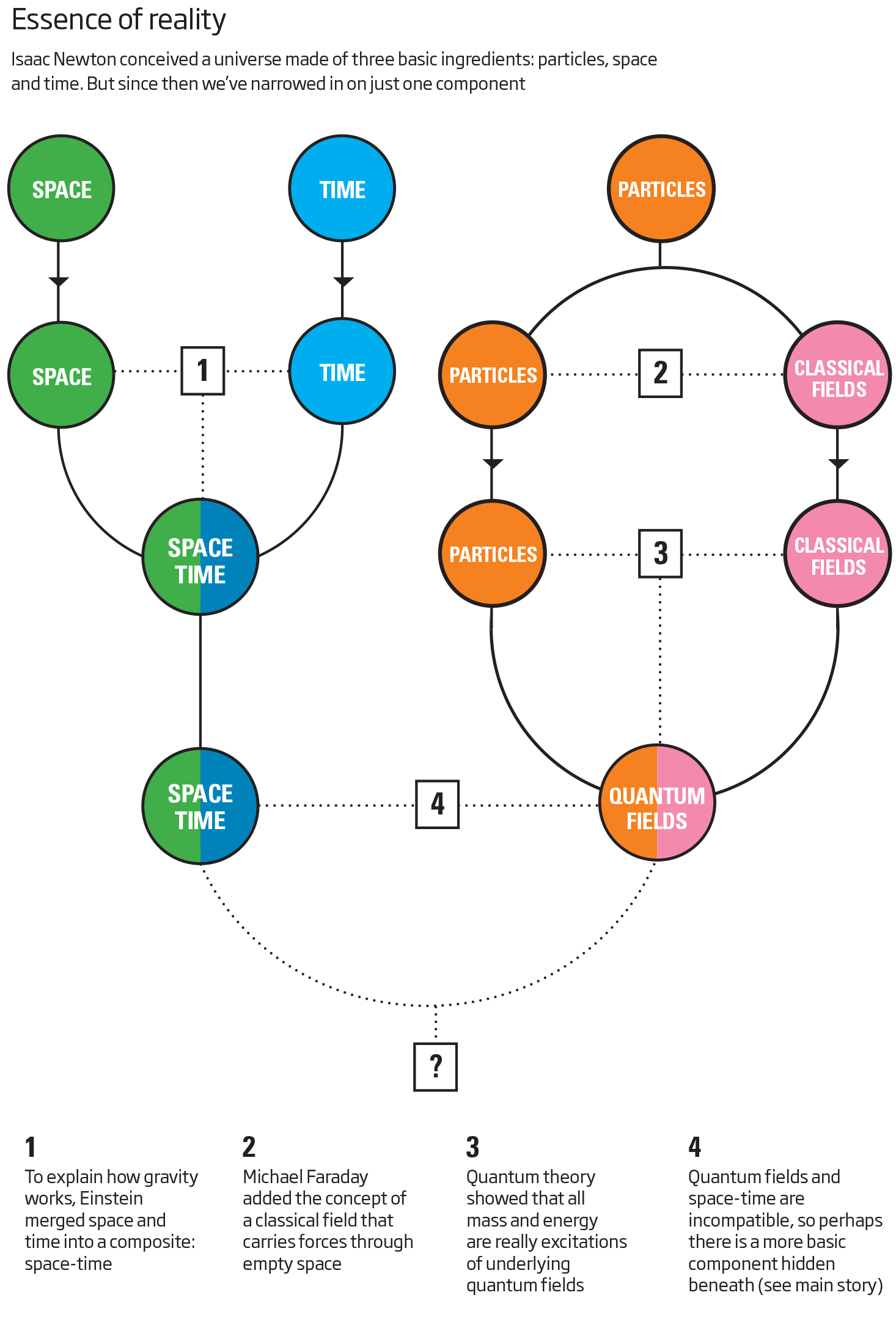
But even without that caveat, Newton’s work didn’t explain everything. Although it provided a description of gravity, the attractive force governing the movement of masses in space, it did not explain what it was. Soon there were other forces, like electromagnetism, which were similarly mysterious. Ever since, we have been embroiled in an ongoing renegotiation of the essential ingredients of reality (see diagram).
Today, the pressing issue is to unify quantum theory, our best description of the world at the smallest scales, with general relativity, Einstein’s masterly theory of gravity. When we try to describe black holes, dense cosmic objects that suck in everything including light, or the big bang, we require both these pillars of modern physics to work together. Then things stop making sense.
“Every tangible aspect of reality is likely to be an illusion”
The trouble is that quantum theory treats forces as coming in discrete chunks called quanta, but general relativity treats gravity as a smooth and continuous force. All efforts to harmonise things by quantising gravity have so far failed – but they have yielded some clues about what might underlie both theories.
The story of the latest revolution in our thinking begins in the late 1990s, when Juan Maldacena at the Institute of Advanced Studies in Princeton, New Jersey, was working on string theory, a proposed route to unifying things based on the idea that elementary particles emerge from the vibrations of one-dimensional “strings”. Maldacena showed that, for a given volume of space-time, a string theory describing gravity inside can be mathematically equivalent to a set of quantum equations, which describe the boundary of the volume but don’t include gravity. It all sounds rather technical, but this “Maldacena duality”, as it came to be known, hinted strongly at a connection between general relativity and quantum mechanics. That made it worth investigation.
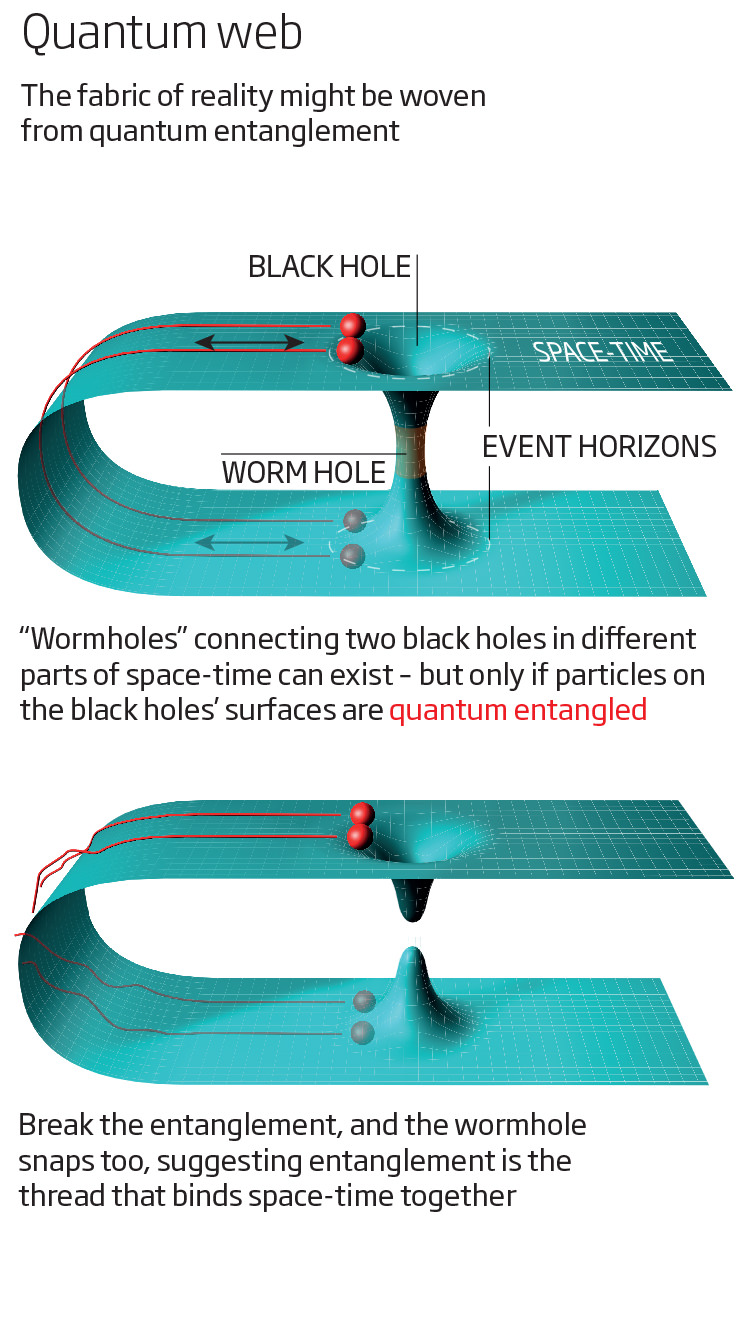
It turned out to have an intriguing link to another concept in physics. In 1935, Einstein and his colleague Nathan Rosen had shown that two black holes could be connected by a peculiarity of space-time, called an Einstein-Rosen bridge – or colloquially, a wormhole. In 2001, Maldacena used his duality to show something extraordinary about wormholes: that they form because the quantum states of the two black holes, as seen from the outside, are entangled, which means they can spookily influence each other’s states over distance.
Then in 2009, Mark Van Raamsdonk at the University of British Columbia in Canada, began looking at what happens if you change the amount of entanglement between the black holes. He found that this controlled the width of the wormhole: increase it, and the wormhole expands, decrease it and you can snap the connection entirely (see diagram). It was as if entanglement, a quantum phenomenon, could create space-time, as described by general relativity (New Scientist, 7 November 2015, p 30).
Raamsdonk’s work led Maldacena and his colleague Leonard Susskind of Stanford University in California to an audacious hypothesis: that space-time in general is created by entanglement. It was a glimpse of a lower level of reality.

Make some space

But only a glimpse. The idea is not yet a fully formed theory, as became clear when Susskind started to mull it over in more detail in the context of a different quirk of space-time: single black holes. These cosmic monsters gobble up matter and create vast swathes of space-time in their innards. It became clear that entanglement can’t account for all that virgin space-time. “The numerical value of the entanglement is not big enough to explain what happens behind black holes’ horizons,” says Susskind.


That needn’t be game over though. “There is another element, the capacity for complexity, which goes way beyond the capacity for entanglement,” says Susskind. Quantum systems can exist in a superposition of many different states at once, and complexity is a property that grows exponentially with the number of states. It’s the growth of black holes’ quantum complexity that Susskind reckons might be connected to the growth of space-time inside them, though he doesn’t yet have a clear sense of how that would work.
There is, however, a more fundamental objection to all this. The suggestion that entanglement can create space-time was spawned initially by the Maldacena duality, but its underlying mathematics still require a form of space-time to already exist. For Sean Carroll of the California Institute of Technology in Pasadena, the fact that space-time is not being created from scratch makes it problematic to say these quantum phenomena somehow underlie it. He too thinks there might be some fundamental link, and he’s exploring what that might be. But he is not using the duality to do it. “That would be cheating,” he says.
Carroll and his colleagues are taking a different tack. They have left out the confusing entity that is time for the moment (see “One time or another: Our best 5 theories of the fourth dimension“) and begun their work from an abstract mathematical object called a Hilbert space. The elements of this entity represent all the possible states of a quantum system. Any Hilbert space can be thought of as being built up from smaller such spaces. Carroll and his team looked at various Hilbert spaces, identified the smaller constituent spaces each was made from and figured out how much entanglement existed between them. Next, they tried to draw a graph in which the more entangled the parts, the closer they are together. Their question: does such a graph approximate to the familiar, smooth geometry of space?


Essence of reality

For any old graph, the answer was no. “It’ll be a horrible mess,” says Carroll. But when his team sifted through carefully, they did find some graphs that were promising. “There are very specific quantum states that look geometric, and those are the ones we are looking at,” says Carroll. For these, as one moved from one position on the graph to another, the transition was relatively smooth, suggesting the smooth geometry of space as we observe it could emerge from a purely quantum system.
“Saying space and time are made of entanglement only gets us so far”
But both Carroll’s and Maldacena’s lines of attack only take us so far. It is all very well to suggest that space and time are made of quantum entanglement and possibly quantum complexity – but what are they made of? Here is where we edge closer to finding the true bedrock of reality. Because both approaches suggest the same tantalising answer: information.
The mathematician and engineer Claude Shannon gave us a neat way to define information in 1948. He showed that the amount of information in something like a stream of bits or letters is related to its entropy, a measure of disorder. The greater the entropy, the greater the information. For example, a stream of three-bit numbers that are always 000 contains less information than a stream in which the numbers can also be 001, 101 or 111.
So in what sense is information at the root of things? Well, entanglement is information: the greater the entanglement between two systems, the more information they share. But there’s a caveat. The information Shannon defined certainly seems to exist and has real effects. Experiments just last year showed a nanomachine could use information to chill metal. But the sort of quantum information that might underlie space-time must be a little different. The information in a stream of words is about something. By contrast, the quantum information from which space emerges in Carroll’s work is just there. “The quantum state is not of or about anything,” says Carroll. “It is simply our best mathematical description of the universe.”
It actually makes sense that quantum information would be the foundation everything is built on, says Carroll. If you start with quantum mechanics and don’t presume anything else exists, then “basically all you have to play with is quantum information”. That would make information a basic constituent of the universe. “You can find people who think that information is all there is,” says Carroll.
We may even be able to test these ideas, says Sabine Hossenfelder of the Frankfurt Institute for Advanced Studies in Germany. “It’s exceedingly unlikely that something truly perfect ever comes into being,” she says. Just look at some of the most perfect structures we know of: crystals, defined as being composed of precisely repeating molecular units. In real life, even the most pristine crystals have defects. Something similar might happen if space-time is the product of something more basic. “If space-time is not fundamentally the real deal, then there should be defects left in it,” says Hossenfelder. The defects would lead to fleeting deviations from general relativity that we might be able to spot – by monitoring the behaviour of light arriving from billions of light years away, for example.
“There is no boundary to the universe, so the result could still be wrong”
We are a long way from tests like that. And, regardless, we still harbour a nagging doubt about the finding that started it all: the Maldacena duality.
The thing is, the sort of space Maldacena considered is not quite like real space. He was working with something called anti-de Sitter space, which is mathematically simpler. It has a well defined boundary and volume, the very things Maldacena was able to relate to one another.


stairs artwork
Harriet Lee-Merrion

It might sound uncontroversial, but the space we observe in the universe has important differences. Crucially, real space is expanding at an ever-increasing rate. This means that there is no sure boundary to our universe, and so no one is yet clear if the duality holds for real space. If it does not, that throws into question all the results built on top of it.
But although our universe does not have a boundary, it does have a horizon from beyond which nothing, not even light, can reach us. And this might offer a way forward. Last November, Erik Verlinde of the University of Amsterdam used this horizon and a set of assumptions to suggest that entanglement really is related to the space-time of our universe. “It’s motivated by some of the arguments that Susskind and Maldacena had in their picture,” Verlinde says. Based on this leap, he alighted on a modified form of Einstein’s equations and showed how space-time and gravity can emerge from entanglement even in ordinary space.
Though there’s considerable debate over some of Verlinde’s assumptions, there is excitement too. His work provides an explanation for dark energy, one of the most perplexing puzzles in physics. It is thought to be the driving force behind the expansion of space, but this effect arises naturally in Verlinde’s framework without the need for any mystery dark ingredient.
If Verlinde is correct, then maybe information really does underlie space and time in the real world. It would be a world in which every tangible aspect of reality is an illusion, with something ephemeral at the bottom.
But to Susskind at least, the idea that reality might be rooted in 0s and 1s is poetically beautiful. Perhaps, he says, we will one day be able to sum up the universe in a simple epigram: “ah, everything is information”.


Thursday, 19 January 2017

The Reality Hub

There are a number of posts on this site on the topic of reality. This page provides a cross reference to them.

The world's greatest philosophers, from Aristotle to the present day, have debated and wondered about reality, and tried to define it, and they continue to do so. Personally, I'm not sure there's such a thing as a totally objective reality because "reality" can depend on the mind of the observer and their perception, based on the structure of the brain. So I think theories should be considered to be models of reality and it's pointless to ask if any particular model is "real."  All we can do is test theories and verify them to ensure they provide the best models (until we find better ones!)  And ideally, those models would be mathematical because that is the best language we have that is independent of our perceptions. 

The things that we can be sure of (facts) and the things we can have some kind of confidence in (theories), make up only a tiny fraction of reality. Most of our ideas on the nature of reality are speculation. If reality is infinite, as I suspect it is, then we will never know everything about it.

Consider reality as the blue cloud shown below. This diagram is obviously not to scale because the reality cloud could be infinite. Within reality, there is a tiny amount of information which is fact (the yellow circle). We also have theories, which explain more about reality than facts, but which are not themselves facts. They are models of reality. The next widest range of information is hypothesis, and some of this information is shown outside of the reality cloud, because it could be completely wrong.  Beyond hypothesis we have speculation, which is a much bigger space than hypothesis, and again it goes beyond reality because much of what we speculate may not be real.  The space in between speculation and the boundary of reality represents ideas that human beings have yet to imagine or speculated about. 


Religious Apologists will claim reality can be explained by God somehow, but that's a problem for me, because God might not exist. So that's not much of an explanation. When Religious Apologists ask me to explain the nature of reality, I'm afraid I can't give an answer because I don't know, and I would suggest no one knows and I am guessing that no one will ever know! What I can do is provide a wide range of hypotheses and philosophical speculation....

Assumptions about reality

What is reality?

The definition of reality

Is reality made of information? [2010]

Is reality made of information? [2017]

Reality and consciousness

Is reality a simulation?

Does reality exist?

Is reality made of mathematics?

Reality - mainly nothing?


Wednesday, 4 January 2017

Ten Quick Responses to Atheist Claims

A Christian Apologist refers to quick responses for ten "common claims from atheists" by another apologist, namely John Lennox.

I'm not sure how common these claims are (some of them appear to be straw men especially #2) but in any case, I tend to agree with Lennox except for #5 and he's dodged #10.  But mainly he's fairly sensible. My opinions regarding his points are...

1) It's true that the Abrahamic religions are monotheistic whereas Norse and Greek religions are polytheistic. Zeus and Thor are descended from greater entities who sprang from the void (or chaos). The heavens and earth were created by multiple gods rather than one.

2) Science has obviously not explained everything. I'm not aware of anyone making that claim, at least not in the last 120 years. Perhaps it is a reference to Lord Kelvin who said science was pretty much over, just a few years before Max Planck discovered the quantum, and suddenly we realised how little we knew about physics! Obviously if science had explained everything there would be an awful lot of unemployed scientists! I don't believe it will ever happen because as Lennox says, science and religion explain different things (the natural and the supernatural respectively) and therefore it's illogical to have competition between science and religion.

3) To be consistent with point #2 then science should obviously not be opposed to gods (or the supernatural). 

4) Lennox refers to personal experience and that is the best evidence for gods in my opinion.

5) Lennox has fallen into the trap of using the Bible as evidence for God. That's like using The Odyssey as evidence for Zeus.


6) There is a subtle difference between faith and delusion.   A delusion is a belief by an individual, often peculiar to that individual, which is held despite being contradicted by reality or rational argument, and it is often a sign of mental illness.  Faith in this context is defined as: Strong belief in the doctrines of a religion, based on spiritual conviction rather than proof.  So I think it's unfair to claim that religious faith (or spiritual conviction) implies mental illness.


7) I like Lennox's use of football as an analogy for denominations and religions. There are actually many variations of the game across the world, with different rules, different shaped balls and goals, different numbers of players. The rules evolve over time. The version one participates in (if any) is predominantly influenced by birthplace, culture, school, family or peers. 

8) It's nonsense to say the bible is immoral. The concept of morality applies to the actions of people. A book can't be immoral or moral. 
9) Some Christians do take the Bible literally. But I think they are in a small minority nowadays at least from a global perspective.

10) If there was evidence for God I would believe in God. But it seems Lennox cannot provide any. He completely dodged the question for some reason.

Tuesday, 3 January 2017

The Real Problem of Consciousness

Consciousness is a frequent topic with some religious apologists. Typically their argument can be summarised as: science cannot explain consciousness therefore God exists. This is a risky strategy. What would their position be if science did eventually explain consciousness?

Explanations of consciousness and intelligence have been provided previously here and here and here and much is made of the hard problem of consciousness.

But what if there is no hard problem? What if the so-called hard problem is a distraction from the real problem?

This essay is taken from Aeon magazine.


The real problem

It looks like scientists and philosophers might have made consciousness far more mysterious than it needs to be.

By Anil K Seth

Professor of cognitive and computational neuroscience at the University of Sussex, and co-director of the Sackler Centre for Consciousness Science. He is also editor-in-chief of Neuroscience of Consciousness. He lives in Brighton. 

What is the best way to understand consciousness? In philosophy, centuries-old debates continue to rage over whether the Universe is divided, following René Descartes, into ‘mind stuff’ and ‘matter stuff’. But the rise of modern neuroscience has seen a more pragmatic approach gain ground: an approach that is guided by philosophy but doesn’t rely on philosophical research to provide the answers. Its key is to recognise that explaining why consciousness exists at all is not necessary in order to make progress in revealing its material basis – to start building explanatory bridges from the subjective and phenomenal to the objective and measurable.

In my work at the Sackler Centre for Consciousness Science at the University of Sussex in Brighton, I collaborate with cognitive scientists, neuroscientists, psychiatrists, brain imagers, virtual reality wizards and mathematicians – and philosophers too – trying to do just this. And together with other laboratories, we are gaining exciting new insights into consciousness – insights that are making real differences in medicine, and that in turn raise new intellectual and ethical challenges. In my own research, a new picture is taking shape in which conscious experience is seen as deeply grounded in how brains and bodies work together to maintain physiological integrity – to stay alive. In this story, we are conscious ‘beast-machines’, and I hope to show you why.

Let’s begin with David Chalmers’s influential distinction, inherited from Descartes, between the ‘easy problem’ and the ‘hard problem’. The ‘easy problem’ is to understand how the brain (and body) gives rise to perception, cognition, learning and behaviour. The ‘hard’ problem is to understand why and how any of this should be associated with consciousness at all: why aren’t we just robots, or philosophical zombies, without any inner universe? It’s tempting to think that solving the easy problem (whatever this might mean) would get us nowhere in solving the hard problem, leaving the brain basis of consciousness a total mystery.

But there is an alternative, which I like to call the real problem: how to account for the various properties of consciousness in terms of biological mechanisms; without pretending it doesn’t exist (easy problem) and without worrying too much about explaining its existence in the first place (hard problem). (People familiar with ‘neurophenomenology’ will see some similarities with this way of putting things – but there are differences too, as we will see.)

There are some historical parallels for this approach, for example in the study of life. Once, biochemists doubted that biological mechanisms could ever explain the property of being alive. Today, although our understanding remains incomplete, this initial sense of mystery has largely dissolved. Biologists have simply gotten on with the business of explaining the various properties of living systems in terms of underlying mechanisms: metabolism, homeostasis, reproduction and so on. An important lesson here is that life is not ‘one thing’ – rather, it has many potentially separable aspects.

In the same way, tackling the real problem of consciousness depends on distinguishing different aspects of consciousness, and mapping their phenomenological properties (subjective first-person descriptions of what conscious experiences are like) onto underlying biological mechanisms (objective third-person descriptions). A good starting point is to distinguish between conscious level, conscious content, and conscious self. Conscious level has to do with being conscious at all – the difference between being in a dreamless sleep (or under general anaesthesia) and being vividly awake and aware. Conscious contents are what populate your conscious experiences when you are conscious – the sights, sounds, smells, emotions, thoughts and beliefs that make up your inner universe. And among these conscious contents is the specific experience of being you. This is conscious self, and is probably the aspect of consciousness that we cling to most tightly.
tom of Form
What are the fundamental brain mechanisms that underlie our ability to be conscious at all? Importantly, conscious level is not the same as wakefulness. When you dream, you have conscious experiences even though you’re asleep. And in some pathological cases, such as the vegetative state (sometimes called ‘wakeful unawareness’), you can be altogether without consciousness, but still go through cycles of sleep and waking.

So what underlies being conscious specifically, as opposed to just being awake? We know it’s not just the number of neurons involved. The cerebellum (the so-called ‘little brain’ hanging off the back of the cortex) has about four times as many neurons as the rest of the brain, but seems barely involved in maintaining conscious level. It’s not even the overall level of neural activity – your brain is almost as active during dreamless sleep as it is during conscious wakefulness. Rather, consciousness seems to depend on how different parts of the brain speak to each other, in specific ways.

A series of studies by the neuroscientist Marcello Massimini at the University of Milan provides powerful evidence for this view. In these studies, the brain is stimulated by brief pulses of energy – using a technique called transcranial magnetic stimulation (TMS) – and its electrical ‘echoes’ are recorded using EEG. In dreamless sleep and general anaesthesia, these echoes are very simple, like the waves generated by throwing a stone into still water. But during conscious states, a typical echo ranges widely over the cortical surface, disappearing and reappearing in complex patterns. Excitingly, we can now quantify the complexity of these echoes by working out how compressible they are, similar to how simple algorithms compress digital photos into JPEG files. The ability to do this represents a first step towards a ‘consciousness-meter’ that is both practically useful and theoretically motivated.

Complexity measures of consciousness have already been used to track changing levels of awareness across states of sleep and anaesthesia. They can even be used to check for any persistence of consciousness following brain injury, where diagnoses based on a patient’s behaviour are sometimes misleading. At the Sackler Centre, we are working to improve the practicality of these measures by computing ‘brain complexity’ on the basis of spontaneous neural activity – the brain’s ongoing ‘echo’ – without the need for brain stimulation. The promise is that the ability to measure consciousness, to quantify its comings and goings, will transform our scientific understanding in the same way that our physical understanding of heat (as average molecular kinetic energy) depended on the development, in the 18th century, of the first reliable thermometers. Lord Kelvin put it this way: ‘In physical science the first essential step in the direction of learning any subject is to find principles of numerical reckoning and practicable methods for measuring some quality connected with it.’ More simply: ‘To measure is to know.’

But what is the ‘quality’ that brain-complexity measures are measuring? This is where new theoretical ideas about consciousness come into play. These start in the late 1990s, when Gerald Edelman (my former mentor at the Neurosciences Institute in San Diego) and Giulio Tononi – now at the University of Wisconsin in Madison – argued that conscious experiences were unique in being simultaneously highly ‘informative’ and highly ‘integrated’.

Consciousness is informative in the sense that every experience is different from every other experience you have ever had, or ever could have.

Looking past the desk in front of me through the window beyond, I have never before experienced precisely this configuration of coffee cups, computers and clouds – an experience that is even more distinctive when combined with all the other perceptions, emotions and thoughts simultaneously present. Every conscious experience involves a very large reduction of uncertainty – at any time, we have one experience out of vastly many possible experiences – and reduction of uncertainty is what mathematically we mean by ‘information’.

Consciousness is integrated in the sense that every conscious experience appears as a unified scene. We do not experience colours separately from their shapes, nor objects independently of their background. The many different elements of my conscious experience right now – computers and coffee cups, as well as the gentle sounds of Bach and my worries about what to write next – seem tied together in a deep way, as aspects of a single encompassing state of consciousness.

It turns out that the maths that captures this co-existence of information and integration maps onto the emerging measures of brain complexity I described above. This is no accident – it is an application of the ‘real problem’ strategy. We’re taking a description of consciousness at the level of subjective experience, and mapping it to objective descriptions of brain mechanisms.

Some researchers take these ideas much further, to grapple with the hard problem itself. Tononi, who pioneered this approach, argues that consciousness simply is integrated information. This is an intriguing and powerful proposal, but it comes at the cost of admitting that consciousness could be present everywhere and in everything, a philosophical view known as panpsychism. The additional mathematical contortions needed also mean that, in practice, integrated information becomes impossible to measure for any real complex system. This is an instructive example of how targeting the hard problem, rather than the real problem, can slow down or even stop experimental progress.

When we are conscious, we are conscious of something. What in the brain determines the contents of consciousness? The standard approach to this question has been to look for so-called ‘neural correlates of consciousness’ (NCCs). In the 1990s, Francis Crick and Christof Koch defined an NCC as ‘the minimal set of neuronal events and mechanisms jointly sufficient for a specific conscious percept’. This definition has served very well over the past quarter century because it leads directly to experiments. We can compare conscious perception with unconscious perception and look for the difference in brain activity, using (for example) EEG and functional MRI. There are many ways of doing this. One of the most popular is binocular rivalry, in which different images are presented to each eye so that conscious perception flips from one to the other (while sensory input remains constant). Another is masking, in which a briefly flashed image is rapidly followed by a meaningless pattern. Here, whether the first image is consciously perceived depends on the delay between the image and the mask.

Experiments such as these have identified brain regions that are consistently associated with conscious perception, independently of whether that perception is visual, auditory or in some other sensory modality. The most recent chapter in this story involves experiments that try to distinguish between those brain regions involved in reporting about a conscious percept (e.g., saying: ‘I see a face!’) from those involved in generating the conscious percept itself. But as powerful as these experiments are, they do not really address the ‘real’ problem of consciousness. To say that a posterior cortical ‘hot-spot’ (for instance) is reliably activated during conscious perception does not explain why activity in that region should be associated with consciousness. For this, we need a general theory of perception that describes what brains do, not just where they do it.

In the 19th century, the German polymath Hermann von Helmholtz proposed that the brain is a prediction machine, and that what we see, hear and feel are nothing more than the brain’s best guesses about the causes of its sensory inputs. Think of it like this. The brain is locked inside a bony skull. All it receives are ambiguous and noisy sensory signals that are only indirectly related to objects in the world. Perception must therefore be a process of inference, in which indeterminate sensory signals are combined with prior expectations or ‘beliefs’ about the way the world is, to form the brain’s optimal hypotheses of the causes of these sensory signals – of coffee cups, computers and clouds. What we see is the brain’s ‘best guess’ of what’s out there.

It’s easy to find examples of predictive perception both in the lab and in everyday life. Walking out on a foggy morning, if we expect to meet a friend at a bus stop, we might perceive her to be there, until closer inspection reveals a stranger. We can also hear words in nonsensical streams of noise, if we are expecting these words (play ‘Stairway to Heaven’ backwards and you can hear satanic poetry). Even very basic elements of perception are shaped by unconscious beliefs encoded in our visual systems. Our brains have evolved to assume (believe) that light comes from above, which influences the way we perceive shapes in shadow.

The classical view of perception is that the brain processes sensory information in a bottom-up or ‘outside-in’ direction: sensory signals enter through receptors (for example, the retina) and then progress deeper into the brain, with each stage recruiting increasingly sophisticated and abstract processing. In this view, the perceptual ‘heavy-lifting’ is done by these bottom-up connections. The Helmholtzian view inverts this framework, proposing that signals flowing into the brain from the outside world convey only prediction errors – the differences between what the brain expects and what it receives. Perceptual content is carried by perceptual predictions flowing in the opposite (top-down) direction, from deep inside the brain out towards the sensory surfaces. Perception involves the minimisation of prediction error simultaneously across many levels of processing within the brain’s sensory systems, by continuously updating the brain’s predictions. In this view, which is often called ‘predictive coding’ or ‘predictive processing’, perception is a controlled hallucination, in which the brain’s hypotheses are continually reined in by sensory signals arriving from the world and the body. ‘A fantasy that coincides with reality,’ as the psychologist Chris Frith eloquently put it in Making Up the Mind (2007).

Armed with this theory of perception, we can return to consciousness. Now, instead of asking which brain regions correlate with conscious (versus unconscious) perception, we can ask: which aspects of predictive perception go along with consciousness?

A number of experiments are now indicating that consciousness depends more on perceptual predictions, than on prediction errors. In 2001, Alvaro Pascual-Leone and Vincent Walsh at Harvard Medical School asked people to report the perceived direction of movement of clouds of drifting dots (so-called ‘random dot kinematograms’). They used TMS to specifically interrupt top-down signalling across the visual cortex, and they found that this abolished conscious perception of the motion, even though bottom-up signals were left intact.

More recently, in my lab, we’ve been probing the predictive mechanisms of conscious perception in more detail. In several experiments – using variants of the binocular rivalry method mentioned earlier – we’ve found that people consciously see what they expect, rather than what violates their expectations. We’ve also discovered that the brain imposes its perceptual predictions at preferred points (or phases) within the so-called ‘alpha rhythm’, which is an oscillation in the EEG signal at about 10 Hz that is especially prominent over the visual areas of the brain. This is exciting because it gives us a glimpse of how the brain might actually implement something like predictive perception, and because it sheds new light on a well-known phenomenon of brain activity, the alpha rhythm, whose function so far has remained elusive.

Predictive processing can also help us understand unusual forms of visual experience, such as the hallucinations that can accompany psychosis or psychedelic trips. The basic idea is that hallucinations occur when the brain pays too little attention to incoming sensory signals, so that perception becomes unusually dominated by the brain’s prior expectations. Different sorts of hallucination – from simple geometric experiences of lines, patterns and textures to rich hallucinatory narratives full of objects and people – can be explained by the brain’s over-eagerness to confirm its predictions at different levels in the cortical hierarchy. This research has significant clinical promise since it gets at the mechanisms that underlie the symptoms of psychiatric conditions, in much the same way that antibiotics tackle the causes of infection while painkillers do not.

Of the many distinctive experiences within our inner universes, one is very special. This is the experience of being you. It’s tempting to take experiences of selfhood for granted, since they always seem to be present, and we usually feel a sense of continuity in our subjective existence (except, of course, when emerging from general anaesthesia). But just as consciousness is not just one thing, conscious selfhood is also best understood as a complex construction generated by the brain.

There is the bodily self, which is the experience of being a body and of having a particular body. There is the perspectival self, which is the experience of perceiving the world from a particular first-person point of view. The volitional self involves experiences of intention and of agency – of urges to do this or that, and of being the causes of things that happen. At higher levels, we encounter narrative and social selves. The narrative self is where the ‘I’ comes in, as the experience of being a continuous and distinctive person over time, built from a rich set of autobiographical memories. And the social self is that aspect of self-experience that is refracted through the perceived minds of others, shaped by our unique social milieu.

In daily life, it can be hard to differentiate these dimensions of selfhood. We move through the world as seemingly unified wholes, our experience of bodily self seamlessly integrated with our memories from the past, and with our experiences of volition and agency. But introspection can be a poor guide. Many experiments and neuropsychological case studies tell a different story, one in which the brain actively and continuously generates and coordinates these diverse aspects of self-experience.

Let’s take the example of bodily selfhood. In the famous ‘rubber-hand illusion’, I ask you to focus your attention on a fake hand while your real hand is kept out of sight. If I then simultaneously stroke your real hand and the fake hand with a soft paintbrush, you may develop the uncanny feeling that the fake hand is now, somehow, part of your body. This reveals a surprising flexibility in how we experience ‘owning’ our bodies and raises a question: how does the brain decide which parts of the world are its body, and which aren’t?

To answer this, we can appeal to the same process that underlies other forms of perception. The brain makes its ‘best guess’, based on its prior beliefs or expectations, and the available sensory data. In this case, the relevant sensory data include signals specific to the body, as well as the classic senses such as vision and touch. These bodily senses include proprioception, which signals the body’s configuration in space, and interoception, which involves a raft of inputs that convey information from inside the body, such as blood pressure, gastric tension, heartbeat and so on. The experience of embodied selfhood depends on predictions about body-related causes of sensory signals across interoceptive and proprioceptive channels, as well as across the classic senses. Our experiences of being and having a body are ‘controlled hallucinations’ of a very distinctive kind.

Research in our lab is supporting this idea. In one experiment, we used so-called augmented reality to develop a new version of the rubber-hand illusion, designed to examine the effects of interoceptive signals on body ownership. Participants viewed their surroundings through a head-mounted display, focusing on a virtual reality version of their hand, which appeared in front of them. This virtual hand was programmed to flash gently red, either in time or out of time with their heartbeat. We predicted that people would experience a greater sense of identity with the virtual hand when it was pulsing synchronously with their heartbeat, and this is just what we found. Other laboratories are finding that similar principles apply to other aspects of conscious self. For example, we experience agency over events when incoming sensory data match the predicted consequences of actions – and breakdowns in experienced agency, which can happen in conditions such as schizophrenia – can be traced to abnormalities in this predictive process.

These findings take us all the way back to Descartes. Instead of ‘I think therefore I am’ we can say: ‘I predict (myself) therefore I am.’ The specific experience of being you (or me) is nothing more than the brain’s best guess of the causes of self-related sensory signals.

There is a final twist to this story. Predictive models are good not only for figuring out the causes of sensory signals, they also allow the brain to control or regulate these causes, by changing sensory data to conform to existing predictions (this is sometimes called ‘active inference’). When it comes to the self, especially its deeply embodied aspects, effective regulation is arguably more important than accurate perception. As long as our heartbeat, blood pressure and other physiological quantities remain within viable bounds, it might not matter if we lack detailed perceptual representations. This might have something to do with the distinctive character of experiences of ‘being a body’, in comparison with experiences of objects in the world – or of the body as an object.

And this returns us one last time to Descartes. In dissociating mind from body, he argued that non-human animals were nothing more than ‘beast machines’ without any inner universe. In his view, basic processes of physiological regulation had little or nothing to do with mind or consciousness. I’ve come to think the opposite. It now seems to me that fundamental aspects of our experiences of conscious selfhood might depend on control-oriented predictive perception of our messy physiology, of our animal blood and guts. We are conscious selves because we too are beast machines – self-sustaining flesh-bags that care about their own persistence.