Showing posts with label Consciousness. Show all posts

Tuesday, 3 January 2017

The Real Problem of Consciousness

Consciousness is a frequent topic with some religious apologists. Typically their argument can be summarised as: science cannot explain consciousness therefore God exists. This is a risky strategy. What would their position be if science did eventually explain consciousness?

Explanations of consciousness and intelligence have been provided previously here and here and here and much is made of the hard problem of consciousness.

But what if there is no hard problem? What if the so-called hard problem is a distraction from the real problem?

This essay is taken from Aeon magazine.


The real problem

It looks like scientists and philosophers might have made consciousness far more mysterious than it needs to be.

By Anil K Seth

Professor of cognitive and computational neuroscience at the University of Sussex, and co-director of the Sackler Centre for Consciousness Science. He is also editor-in-chief of Neuroscience of Consciousness. He lives in Brighton. 

What is the best way to understand consciousness? In philosophy, centuries-old debates continue to rage over whether the Universe is divided, following RenĂ© Descartes, into ‘mind stuff’ and ‘matter stuff’. But the rise of modern neuroscience has seen a more pragmatic approach gain ground: an approach that is guided by philosophy but doesn’t rely on philosophical research to provide the answers. Its key is to recognise that explaining why consciousness exists at all is not necessary in order to make progress in revealing its material basis – to start building explanatory bridges from the subjective and phenomenal to the objective and measurable.

In my work at the Sackler Centre for Consciousness Science at the University of Sussex in Brighton, I collaborate with cognitive scientists, neuroscientists, psychiatrists, brain imagers, virtual reality wizards and mathematicians – and philosophers too – trying to do just this. And together with other laboratories, we are gaining exciting new insights into consciousness – insights that are making real differences in medicine, and that in turn raise new intellectual and ethical challenges. In my own research, a new picture is taking shape in which conscious experience is seen as deeply grounded in how brains and bodies work together to maintain physiological integrity – to stay alive. In this story, we are conscious ‘beast-machines’, and I hope to show you why.

Let’s begin with David Chalmers’s influential distinction, inherited from Descartes, between the ‘easy problem’ and the ‘hard problem’. The ‘easy problem’ is to understand how the brain (and body) gives rise to perception, cognition, learning and behaviour. The ‘hard’ problem is to understand why and how any of this should be associated with consciousness at all: why aren’t we just robots, or philosophical zombies, without any inner universe? It’s tempting to think that solving the easy problem (whatever this might mean) would get us nowhere in solving the hard problem, leaving the brain basis of consciousness a total mystery.

But there is an alternative, which I like to call the real problem: how to account for the various properties of consciousness in terms of biological mechanisms; without pretending it doesn’t exist (easy problem) and without worrying too much about explaining its existence in the first place (hard problem). (People familiar with ‘neurophenomenology’ will see some similarities with this way of putting things – but there are differences too, as we will see.)

There are some historical parallels for this approach, for example in the study of life. Once, biochemists doubted that biological mechanisms could ever explain the property of being alive. Today, although our understanding remains incomplete, this initial sense of mystery has largely dissolved. Biologists have simply gotten on with the business of explaining the various properties of living systems in terms of underlying mechanisms: metabolism, homeostasis, reproduction and so on. An important lesson here is that life is not ‘one thing’ – rather, it has many potentially separable aspects.

In the same way, tackling the real problem of consciousness depends on distinguishing different aspects of consciousness, and mapping their phenomenological properties (subjective first-person descriptions of what conscious experiences are like) onto underlying biological mechanisms (objective third-person descriptions). A good starting point is to distinguish between conscious level, conscious content, and conscious self. Conscious level has to do with being conscious at all – the difference between being in a dreamless sleep (or under general anaesthesia) and being vividly awake and aware. Conscious contents are what populate your conscious experiences when you are conscious – the sights, sounds, smells, emotions, thoughts and beliefs that make up your inner universe. And among these conscious contents is the specific experience of being you. This is conscious self, and is probably the aspect of consciousness that we cling to most tightly.
tom of Form
What are the fundamental brain mechanisms that underlie our ability to be conscious at all? Importantly, conscious level is not the same as wakefulness. When you dream, you have conscious experiences even though you’re asleep. And in some pathological cases, such as the vegetative state (sometimes called ‘wakeful unawareness’), you can be altogether without consciousness, but still go through cycles of sleep and waking.

So what underlies being conscious specifically, as opposed to just being awake? We know it’s not just the number of neurons involved. The cerebellum (the so-called ‘little brain’ hanging off the back of the cortex) has about four times as many neurons as the rest of the brain, but seems barely involved in maintaining conscious level. It’s not even the overall level of neural activity – your brain is almost as active during dreamless sleep as it is during conscious wakefulness. Rather, consciousness seems to depend on how different parts of the brain speak to each other, in specific ways.

A series of studies by the neuroscientist Marcello Massimini at the University of Milan provides powerful evidence for this view. In these studies, the brain is stimulated by brief pulses of energy – using a technique called transcranial magnetic stimulation (TMS) – and its electrical ‘echoes’ are recorded using EEG. In dreamless sleep and general anaesthesia, these echoes are very simple, like the waves generated by throwing a stone into still water. But during conscious states, a typical echo ranges widely over the cortical surface, disappearing and reappearing in complex patterns. Excitingly, we can now quantify the complexity of these echoes by working out how compressible they are, similar to how simple algorithms compress digital photos into JPEG files. The ability to do this represents a first step towards a ‘consciousness-meter’ that is both practically useful and theoretically motivated.

Complexity measures of consciousness have already been used to track changing levels of awareness across states of sleep and anaesthesia. They can even be used to check for any persistence of consciousness following brain injury, where diagnoses based on a patient’s behaviour are sometimes misleading. At the Sackler Centre, we are working to improve the practicality of these measures by computing ‘brain complexity’ on the basis of spontaneous neural activity – the brain’s ongoing ‘echo’ – without the need for brain stimulation. The promise is that the ability to measure consciousness, to quantify its comings and goings, will transform our scientific understanding in the same way that our physical understanding of heat (as average molecular kinetic energy) depended on the development, in the 18th century, of the first reliable thermometers. Lord Kelvin put it this way: ‘In physical science the first essential step in the direction of learning any subject is to find principles of numerical reckoning and practicable methods for measuring some quality connected with it.’ More simply: ‘To measure is to know.’

But what is the ‘quality’ that brain-complexity measures are measuring? This is where new theoretical ideas about consciousness come into play. These start in the late 1990s, when Gerald Edelman (my former mentor at the Neurosciences Institute in San Diego) and Giulio Tononi – now at the University of Wisconsin in Madison – argued that conscious experiences were unique in being simultaneously highly ‘informative’ and highly ‘integrated’.

Consciousness is informative in the sense that every experience is different from every other experience you have ever had, or ever could have.

Looking past the desk in front of me through the window beyond, I have never before experienced precisely this configuration of coffee cups, computers and clouds – an experience that is even more distinctive when combined with all the other perceptions, emotions and thoughts simultaneously present. Every conscious experience involves a very large reduction of uncertainty – at any time, we have one experience out of vastly many possible experiences – and reduction of uncertainty is what mathematically we mean by ‘information’.

Consciousness is integrated in the sense that every conscious experience appears as a unified scene. We do not experience colours separately from their shapes, nor objects independently of their background. The many different elements of my conscious experience right now – computers and coffee cups, as well as the gentle sounds of Bach and my worries about what to write next – seem tied together in a deep way, as aspects of a single encompassing state of consciousness.

It turns out that the maths that captures this co-existence of information and integration maps onto the emerging measures of brain complexity I described above. This is no accident – it is an application of the ‘real problem’ strategy. We’re taking a description of consciousness at the level of subjective experience, and mapping it to objective descriptions of brain mechanisms.

Some researchers take these ideas much further, to grapple with the hard problem itself. Tononi, who pioneered this approach, argues that consciousness simply is integrated information. This is an intriguing and powerful proposal, but it comes at the cost of admitting that consciousness could be present everywhere and in everything, a philosophical view known as panpsychism. The additional mathematical contortions needed also mean that, in practice, integrated information becomes impossible to measure for any real complex system. This is an instructive example of how targeting the hard problem, rather than the real problem, can slow down or even stop experimental progress.

When we are conscious, we are conscious of something. What in the brain determines the contents of consciousness? The standard approach to this question has been to look for so-called ‘neural correlates of consciousness’ (NCCs). In the 1990s, Francis Crick and Christof Koch defined an NCC as ‘the minimal set of neuronal events and mechanisms jointly sufficient for a specific conscious percept’. This definition has served very well over the past quarter century because it leads directly to experiments. We can compare conscious perception with unconscious perception and look for the difference in brain activity, using (for example) EEG and functional MRI. There are many ways of doing this. One of the most popular is binocular rivalry, in which different images are presented to each eye so that conscious perception flips from one to the other (while sensory input remains constant). Another is masking, in which a briefly flashed image is rapidly followed by a meaningless pattern. Here, whether the first image is consciously perceived depends on the delay between the image and the mask.

Experiments such as these have identified brain regions that are consistently associated with conscious perception, independently of whether that perception is visual, auditory or in some other sensory modality. The most recent chapter in this story involves experiments that try to distinguish between those brain regions involved in reporting about a conscious percept (e.g., saying: ‘I see a face!’) from those involved in generating the conscious percept itself. But as powerful as these experiments are, they do not really address the ‘real’ problem of consciousness. To say that a posterior cortical ‘hot-spot’ (for instance) is reliably activated during conscious perception does not explain why activity in that region should be associated with consciousness. For this, we need a general theory of perception that describes what brains do, not just where they do it.

In the 19th century, the German polymath Hermann von Helmholtz proposed that the brain is a prediction machine, and that what we see, hear and feel are nothing more than the brain’s best guesses about the causes of its sensory inputs. Think of it like this. The brain is locked inside a bony skull. All it receives are ambiguous and noisy sensory signals that are only indirectly related to objects in the world. Perception must therefore be a process of inference, in which indeterminate sensory signals are combined with prior expectations or ‘beliefs’ about the way the world is, to form the brain’s optimal hypotheses of the causes of these sensory signals – of coffee cups, computers and clouds. What we see is the brain’s ‘best guess’ of what’s out there.

It’s easy to find examples of predictive perception both in the lab and in everyday life. Walking out on a foggy morning, if we expect to meet a friend at a bus stop, we might perceive her to be there, until closer inspection reveals a stranger. We can also hear words in nonsensical streams of noise, if we are expecting these words (play ‘Stairway to Heaven’ backwards and you can hear satanic poetry). Even very basic elements of perception are shaped by unconscious beliefs encoded in our visual systems. Our brains have evolved to assume (believe) that light comes from above, which influences the way we perceive shapes in shadow.

The classical view of perception is that the brain processes sensory information in a bottom-up or ‘outside-in’ direction: sensory signals enter through receptors (for example, the retina) and then progress deeper into the brain, with each stage recruiting increasingly sophisticated and abstract processing. In this view, the perceptual ‘heavy-lifting’ is done by these bottom-up connections. The Helmholtzian view inverts this framework, proposing that signals flowing into the brain from the outside world convey only prediction errors – the differences between what the brain expects and what it receives. Perceptual content is carried by perceptual predictions flowing in the opposite (top-down) direction, from deep inside the brain out towards the sensory surfaces. Perception involves the minimisation of prediction error simultaneously across many levels of processing within the brain’s sensory systems, by continuously updating the brain’s predictions. In this view, which is often called ‘predictive coding’ or ‘predictive processing’, perception is a controlled hallucination, in which the brain’s hypotheses are continually reined in by sensory signals arriving from the world and the body. ‘A fantasy that coincides with reality,’ as the psychologist Chris Frith eloquently put it in Making Up the Mind (2007).

Armed with this theory of perception, we can return to consciousness. Now, instead of asking which brain regions correlate with conscious (versus unconscious) perception, we can ask: which aspects of predictive perception go along with consciousness?

A number of experiments are now indicating that consciousness depends more on perceptual predictions, than on prediction errors. In 2001, Alvaro Pascual-Leone and Vincent Walsh at Harvard Medical School asked people to report the perceived direction of movement of clouds of drifting dots (so-called ‘random dot kinematograms’). They used TMS to specifically interrupt top-down signalling across the visual cortex, and they found that this abolished conscious perception of the motion, even though bottom-up signals were left intact.

More recently, in my lab, we’ve been probing the predictive mechanisms of conscious perception in more detail. In several experiments – using variants of the binocular rivalry method mentioned earlier – we’ve found that people consciously see what they expect, rather than what violates their expectations. We’ve also discovered that the brain imposes its perceptual predictions at preferred points (or phases) within the so-called ‘alpha rhythm’, which is an oscillation in the EEG signal at about 10 Hz that is especially prominent over the visual areas of the brain. This is exciting because it gives us a glimpse of how the brain might actually implement something like predictive perception, and because it sheds new light on a well-known phenomenon of brain activity, the alpha rhythm, whose function so far has remained elusive.

Predictive processing can also help us understand unusual forms of visual experience, such as the hallucinations that can accompany psychosis or psychedelic trips. The basic idea is that hallucinations occur when the brain pays too little attention to incoming sensory signals, so that perception becomes unusually dominated by the brain’s prior expectations. Different sorts of hallucination – from simple geometric experiences of lines, patterns and textures to rich hallucinatory narratives full of objects and people – can be explained by the brain’s over-eagerness to confirm its predictions at different levels in the cortical hierarchy. This research has significant clinical promise since it gets at the mechanisms that underlie the symptoms of psychiatric conditions, in much the same way that antibiotics tackle the causes of infection while painkillers do not.

Of the many distinctive experiences within our inner universes, one is very special. This is the experience of being you. It’s tempting to take experiences of selfhood for granted, since they always seem to be present, and we usually feel a sense of continuity in our subjective existence (except, of course, when emerging from general anaesthesia). But just as consciousness is not just one thing, conscious selfhood is also best understood as a complex construction generated by the brain.

There is the bodily self, which is the experience of being a body and of having a particular body. There is the perspectival self, which is the experience of perceiving the world from a particular first-person point of view. The volitional self involves experiences of intention and of agency – of urges to do this or that, and of being the causes of things that happen. At higher levels, we encounter narrative and social selves. The narrative self is where the ‘I’ comes in, as the experience of being a continuous and distinctive person over time, built from a rich set of autobiographical memories. And the social self is that aspect of self-experience that is refracted through the perceived minds of others, shaped by our unique social milieu.

In daily life, it can be hard to differentiate these dimensions of selfhood. We move through the world as seemingly unified wholes, our experience of bodily self seamlessly integrated with our memories from the past, and with our experiences of volition and agency. But introspection can be a poor guide. Many experiments and neuropsychological case studies tell a different story, one in which the brain actively and continuously generates and coordinates these diverse aspects of self-experience.

Let’s take the example of bodily selfhood. In the famous ‘rubber-hand illusion’, I ask you to focus your attention on a fake hand while your real hand is kept out of sight. If I then simultaneously stroke your real hand and the fake hand with a soft paintbrush, you may develop the uncanny feeling that the fake hand is now, somehow, part of your body. This reveals a surprising flexibility in how we experience ‘owning’ our bodies and raises a question: how does the brain decide which parts of the world are its body, and which aren’t?

To answer this, we can appeal to the same process that underlies other forms of perception. The brain makes its ‘best guess’, based on its prior beliefs or expectations, and the available sensory data. In this case, the relevant sensory data include signals specific to the body, as well as the classic senses such as vision and touch. These bodily senses include proprioception, which signals the body’s configuration in space, and interoception, which involves a raft of inputs that convey information from inside the body, such as blood pressure, gastric tension, heartbeat and so on. The experience of embodied selfhood depends on predictions about body-related causes of sensory signals across interoceptive and proprioceptive channels, as well as across the classic senses. Our experiences of being and having a body are ‘controlled hallucinations’ of a very distinctive kind.

Research in our lab is supporting this idea. In one experiment, we used so-called augmented reality to develop a new version of the rubber-hand illusion, designed to examine the effects of interoceptive signals on body ownership. Participants viewed their surroundings through a head-mounted display, focusing on a virtual reality version of their hand, which appeared in front of them. This virtual hand was programmed to flash gently red, either in time or out of time with their heartbeat. We predicted that people would experience a greater sense of identity with the virtual hand when it was pulsing synchronously with their heartbeat, and this is just what we found. Other laboratories are finding that similar principles apply to other aspects of conscious self. For example, we experience agency over events when incoming sensory data match the predicted consequences of actions – and breakdowns in experienced agency, which can happen in conditions such as schizophrenia – can be traced to abnormalities in this predictive process.

These findings take us all the way back to Descartes. Instead of ‘I think therefore I am’ we can say: ‘I predict (myself) therefore I am.’ The specific experience of being you (or me) is nothing more than the brain’s best guess of the causes of self-related sensory signals.

There is a final twist to this story. Predictive models are good not only for figuring out the causes of sensory signals, they also allow the brain to control or regulate these causes, by changing sensory data to conform to existing predictions (this is sometimes called ‘active inference’). When it comes to the self, especially its deeply embodied aspects, effective regulation is arguably more important than accurate perception. As long as our heartbeat, blood pressure and other physiological quantities remain within viable bounds, it might not matter if we lack detailed perceptual representations. This might have something to do with the distinctive character of experiences of ‘being a body’, in comparison with experiences of objects in the world – or of the body as an object.

And this returns us one last time to Descartes. In dissociating mind from body, he argued that non-human animals were nothing more than ‘beast machines’ without any inner universe. In his view, basic processes of physiological regulation had little or nothing to do with mind or consciousness. I’ve come to think the opposite. It now seems to me that fundamental aspects of our experiences of conscious selfhood might depend on control-oriented predictive perception of our messy physiology, of our animal blood and guts. We are conscious selves because we too are beast machines – self-sustaining flesh-bags that care about their own persistence.

Thursday, 29 January 2015

The Mystery of Consciousness

From the Guardian, 21 Jan 2015
By Oliver Burkeman

Why can’t the world’s greatest minds solve the mystery of consciousness?
Philosophers and scientists have been at war for decades over the question of what makes human beings more than complex robots.

David Chalmers Defines the “Hard Problem”
One spring morning in Tucson, Arizona, in 1994, an unknown philosopher named David Chalmers got up to give a talk on consciousness, by which he meant the feeling of being inside your head, looking out – or, to use the kind of language that might give a neuroscientist an aneurysm, of having a soul. Though he didn’t realise it at the time, the young Australian academic was about to ignite a war between philosophers and scientists, by drawing attention to a central mystery of human life – perhaps the central mystery of human life – and revealing how embarrassingly far they were from solving it.

The scholars gathered at the University of Arizona – for what would later go down as a landmark conference on the subject – knew they were doing something edgy: in many quarters, consciousness was still taboo, too weird and new-agey to take seriously, and some of the scientists in the audience were risking their reputations by attending. Yet the first two talks that day, before Chalmers’s, hadn’t proved thrilling. “Quite honestly, they were totally unintelligible and boring – I had no idea what anyone was talking about,” recalled Stuart Hameroff, the Arizona professor responsible for the event. “As the organiser, I’m looking around, and people are falling asleep, or getting restless.” He grew worried. “But then the third talk, right before the coffee break – that was Dave.” With his long, straggly hair and fondness for all-body denim, the 27-year-old Chalmers looked like he’d got lost en route to a Metallica concert. “He comes on stage, hair down to his butt, he’s prancing around like Mick Jagger,” Hameroff said. “But then he speaks. And that’s when everyone wakes up.”

The brain, Chalmers began by pointing out, poses all sorts of problems to keep scientists busy. How do we learn, store memories, or perceive things? How do you know to jerk your hand away from scalding water, or hear your name spoken across the room at a noisy party? But these were all “easy problems”, in the scheme of things: given enough time and money, experts would figure them out. There was only one truly hard problem of consciousness, Chalmers said. It was a puzzle so bewildering that, in the months after his talk, people started dignifying it with capital letters – the Hard Problem of Consciousness – and it’s this: why on earth should all those complicated brain processes feel like anything from the inside? Why aren’t we just brilliant robots, capable of retaining information, of responding to noises and smells and hot saucepans, but dark inside, lacking an inner life? And how does the brain manage it? How could the 1.4kg lump of moist, pinkish-beige tissue inside your skull give rise to something as mysterious as the experience of being that pinkish-beige lump, and the body to which it is attached?
What jolted Chalmers’s audience from their torpor was how he had framed the question. “At the coffee break, I went around like a playwright on opening night, eavesdropping,” Hameroff said. “And everyone was like: ‘Oh! The Hard Problem! The Hard Problem! That’s why we’re here!’”

Philosophers had pondered the so-called “mind-body problem” for centuries. But Chalmers’s particular manner of reviving it “reached outside philosophy and galvanised everyone. It defined the field. It made us ask: what the hell is this that we’re dealing with here?”

The Hard Problem Remains
Two decades later, we know an astonishing amount about the brain: you can’t follow the news for a week without encountering at least one more tale about scientists discovering the brain region associated with gambling, or laziness, or love at first sight, or regret – and that’s only the research that makes the headlines. Meanwhile, the field of artificial intelligence – which focuses on recreating the abilities of the human brain, rather than on what it feels like to be one – has advanced stupendously. But like an obnoxious relative who invites himself to stay for a week and then won’t leave, the Hard Problem remains. When I stubbed my toe on the leg of the dining table this morning, as any student of the brain could tell you, nerve fibres called “C-fibres” shot a message to my spinal cord, sending neurotransmitters to the part of my brain called the thalamus, which activated (among other things) my limbic system. Fine. But how come all that was accompanied by an agonising flash of pain? And what is pain, anyway?

Questions like these, which straddle the border between science and philosophy, make some experts openly angry. They have caused others to argue that conscious sensations, such as pain, don’t really exist, no matter what I felt as I hopped in anguish around the kitchen; or, alternatively, that plants and trees must also be conscious. The Hard Problem has prompted arguments in serious journals about what is going on in the mind of a zombie, or – to quote the title of a famous 1974 paper by the philosopher Thomas Nagel – the question “What is it like to be a bat?” Some argue that the problem marks the boundary not just of what we currently know, but of what science could ever explain. On the other hand, in recent years, a handful of neuroscientists have come to believe that it may finally be about to be solved – but only if we are willing to accept the profoundly unsettling conclusion that computers or the internet might soon become conscious, too.
Next week, the conundrum will move further into public awareness with the opening of Tom Stoppard’s new play, The Hard Problem, at the National Theatre – the first play Stoppard has written for the National since 2006, and the last that the theatre’s head, Nicholas Hytner, will direct before leaving his post in March. The 77-year-old playwright has revealed little about the play’s contents, except that it concerns the question of “what consciousness is and why it exists”, considered from the perspective of a young researcher played by Olivia Vinall. Speaking to the Daily Mail, Stoppard also clarified a potential misinterpretation of the title. “It’s not about erectile dysfunction,” he said.

Stoppard’s work has long focused on grand, existential themes, so the subject is fitting: when conversation turns to the Hard Problem, even the most stubborn rationalists lapse quickly into musings on the meaning of life. Christof Koch, the chief scientific officer at the Allen Institute for Brain Science, and a key player in the Obama administration’s multibillion-dollar initiative to map the human brain, is about as credible as neuroscientists get. But, he told me in December:
“I think the earliest desire that drove me to study consciousness was that I wanted, secretly, to show myself that it couldn’t be explained scientifically. I was raised Roman Catholic, and I wanted to find a place where I could say: OK, here, God has intervened. God created souls, and put them into people.” Koch assured me that he had long ago abandoned such improbable notions. Then, not much later, and in all seriousness, he said that on the basis of his recent research he thought it wasn’t impossible that his iPhone might have feelings.

Cartesian Dualism
By the time Chalmers delivered his speech in Tucson, science had been vigorously attempting to ignore the problem of consciousness for a long time. The source of the animosity dates back to the 1600s, when RenĂ© Descartes identified the dilemma that would tie scholars in knots for years to come. On the one hand, Descartes realised, nothing is more obvious and undeniable than the fact that you’re conscious. In theory, everything else you think you know about the world could be an elaborate illusion cooked up to deceive you – at this point, present-day writers invariably invoke The Matrix – but your consciousness itself can’t be illusory. On the other hand, this most certain and familiar of phenomena obeys none of the usual rules of science. It doesn’t seem to be physical. It can’t be observed, except from within, by the conscious person. It can’t even really be described. The mind, Descartes concluded, must be made of some special, immaterial stuff that didn’t abide by the laws of nature; it had been bequeathed to us by God.

The emergence of Neuroscience
This religious and rather hand-wavy position, known as Cartesian dualism, remained the governing assumption into the 18th century and the early days of modern brain study. But it was always bound to grow unacceptable to an increasingly secular scientific establishment that took physicalism – the position that only physical things exist – as its most basic principle. And yet, even as neuroscience gathered pace in the 20th century, no convincing alternative explanation was forthcoming. So little by little, the topic became taboo. Few people doubted that the brain and mind were very closely linked: if you question this, try stabbing your brain repeatedly with a kitchen knife, and see what happens to your consciousness. But how they were linked – or if they were somehow exactly the same thing – seemed a mystery best left to philosophers in their armchairs. As late as 1989, writing in the International Dictionary of Psychology, the British psychologist Stuart Sutherland could irascibly declare of consciousness that “it is impossible to specify what it is, what it does, or why it evolved. Nothing worth reading has been written on it.”

It was only in 1990 that Francis Crick, the joint discoverer of the double helix, used his position of eminence to break ranks. Neuroscience was far enough along by now, he declared in a slightly tetchy paper co-written with Christof Koch, that consciousness could no longer be ignored. “It is remarkable,” they began, “that most of the work in both cognitive science and the neurosciences makes no reference to consciousness” – partly, they suspected, “because most workers in these areas cannot see any useful way of approaching the problem”. They presented their own “sketch of a theory”, arguing that certain neurons, firing at certain frequencies, might somehow be the cause of our inner awareness – though it was not clear how.
“People thought I was crazy to be getting involved,” Koch recalled. “A senior colleague took me out to lunch and said, yes, he had the utmost respect for Francis, but Francis was a Nobel laureate and a half-god and he could do whatever he wanted, whereas I didn’t have tenure yet, so I should be incredibly careful. Stick to more mainstream science! These fringey things – why not leave them until retirement, when you’re coming close to death, and you can worry about the soul and stuff like that?”

It was around this time that David Chalmers started talking about zombies.
Zombies
As a child, Chalmers was short-sighted in one eye, and he vividly recalls the day he was first fitted with glasses to rectify the problem. “Suddenly I had proper binocular vision,” he said. “And the world just popped out. It was three-dimensional to me in a way it hadn’t been.” He thought about that moment frequently as he grew older. Of course, you could tell a simple mechanical story about what was going on in the lens of his glasses, his eyeball, his retina, and his brain. “But how does that explain the way the world just pops out like that?” To a physicalist, the glasses-eyeball-retina story is the only story. But to a thinker of Chalmers’s persuasion, it was clear that it wasn’t enough: it told you what the machinery of the eye was doing, but it didn’t begin to explain that sudden, breath-taking experience of depth and clarity.

Chalmers’s “zombie” thought experiment is his attempt to show why the mechanical account is not enough – why the mystery of conscious awareness goes deeper than a purely material science can explain.

“Look, I’m not a zombie, and I pray that you’re not a zombie,” Chalmers said, one Sunday before Christmas, “but the point is that evolution could have produced zombies instead of conscious creatures – and it didn’t!” We were drinking espressos in his faculty apartment at New York University, where he recently took up a full-time post at what is widely considered the leading philosophy department in the Anglophone world; boxes of his belongings, shipped over from Australia, lay unpacked around his living-room. Chalmers, now 48, recently cut his hair in a concession to academic respectability, and he wears less denim, but his ideas remain as heavy-metal as ever. The zombie scenario goes as follows: imagine that you have a doppelgänger. This person physically resembles you in every respect, and behaves identically to you; he or she holds conversations, eats and sleeps, looks happy or anxious precisely as you do. The sole difference is that the doppelgänger has no consciousness; this – as opposed to a groaning, blood-spattered walking corpse from a movie – is what philosophers mean by a “zombie”.
Such non-conscious humanoids don’t exist, of course. (Or perhaps it would be better to say that I know I’m not one, anyhow; I could never know for certain that you aren’t.) But the point is that, in principle, it feels as if they could. Evolution might have produced creatures that were atom-for-atom the same as humans, capable of everything humans can do, except with no spark of awareness inside. As Chalmers explained: “I’m talking to you now, and I can see how you’re behaving; I could do a brain scan, and find out exactly what’s going on in your brain – yet it seems it could be consistent with all that evidence that you have no consciousness at all.” If you were approached by me and my doppelgänger, not knowing which was which, not even the most powerful brain scanner in existence could tell us apart. And the fact that one can even imagine this scenario is sufficient to show that consciousness can’t just be made of ordinary physical atoms. So consciousness must, somehow, be something extra – an additional ingredient in nature.

Chalmers recently cut his hair and he wears less denim, but his ideas remain as heavy-metal as ever
It would be understating things a bit to say that this argument wasn’t universally well-received when Chalmers began to advance it, most prominently in his 1996 book The Conscious Mind. The withering tone of the philosopher Massimo Pigliucci sums up the thousands of words that have been written attacking the zombie notion: “Let’s relegate zombies to B-movies and try to be a little more serious about our philosophy, shall we?” Yes, it may be true that most of us, in our daily lives, think of consciousness as something over and above our physical being – as if your mind were “a chauffeur inside your own body”, to quote the spiritual author Alan Watts. But to accept this as a scientific principle would mean rewriting the laws of physics. Everything we know about the universe tells us that reality consists only of physical things: atoms and their component particles, busily colliding and combining. Above all, critics point out, if this non-physical mental stuff did exist, how could it cause physical things to happen – as when the feeling of pain causes me to jerk my fingers away from the saucepan’s edge?

Nonetheless, just occasionally, science has dropped tantalising hints that this spooky extra ingredient might be real. In the 1970s, at what was then the National Hospital for Nervous Diseases in London, the neurologist Lawrence Weiskrantz encountered a patient, known as “DB”, with a blind spot in his left visual field, caused by brain damage. Weiskrantz showed him patterns of striped lines, positioned so that they fell on his area of blindness, then asked him to say whether the stripes were vertical or horizontal. Naturally, DB protested that he could see no stripes at all. But Weiskrantz insisted that he guess the answers anyway – and DB got them right almost 90% of the time. Apparently, his brain was perceiving the stripes without his mind being conscious of them. One interpretation is that DB was a semi-zombie, with a brain like any other brain, but partially lacking the magical add-on of consciousness.
Chalmers knows how wildly improbable his ideas can seem, and takes this in his stride: at philosophy conferences, he is fond of clambering on stage to sing The Zombie Blues, a lament about the miseries of having no consciousness. (“I act like you act / I do what you do / But I don’t know / What it’s like to be you.”) “The conceit is: wouldn’t it be a drag to be a zombie? Consciousness is what makes life worth living, and I don’t even have that: I’ve got the zombie blues.” The song has improved since its debut more than a decade ago, when he used to try to hold a tune. “Now I’ve realised it sounds better if you just shout,” he said.

Is Consciousness an Illusion?

The consciousness debates have provoked more mudslinging and fury than most in modern philosophy, perhaps because of how baffling the problem is: opposing combatants tend not merely to disagree, but to find each other’s positions manifestly preposterous. An admittedly extreme example concerns the Canadian-born philosopher Ted Honderich, whose book On Consciousness was described, in an article by his fellow philosopher Colin McGinn in 2007, as “banal and pointless”, “excruciating”, “absurd”, running “the full gamut from the mediocre to the ludicrous to the merely bad”. McGinn added, in a footnote: “The review that appears here is not as I originally wrote it. The editors asked me to ‘soften the tone’ of the original [and] I have done so.” (The attack may have been partly motivated by a passage in Honderich’s autobiography, in which he mentions “my small colleague Colin McGinn”; at the time, Honderich told this newspaper he’d enraged McGinn by referring to a girlfriend of his as “not as plain as the old one”.)

[Also see "The Grand Illusion" here]

McGinn, to be fair, has made a career from such hatchet jobs. But strong feelings only slightly more politely expressed are commonplace. Not everybody agrees there is a Hard Problem to begin with – making the whole debate kickstarted by Chalmers an exercise in pointlessness. Daniel Dennett, the high-profile atheist and professor at Tufts University outside Boston, argues that consciousness, as we think of it, is an illusion: there just isn’t anything in addition to the spongy stuff of the brain, and that spongy stuff doesn’t actually give rise to something called consciousness. Common sense may tell us there’s a subjective world of inner experience – but then common sense told us that the sun orbits the Earth, and that the world was flat. Consciousness, according to Dennett’s theory, is like a conjuring trick: the normal functioning of the brain just makes it look as if there is something non-physical going on.

To look for a real, substantive thing called consciousness, Dennett argues, is as silly as insisting that characters in novels, such as Sherlock Holmes or Harry Potter, must be made up of a peculiar substance named “fictoplasm”; the idea is absurd and unnecessary, since the characters do not exist to begin with.

This is the point at which the debate tends to collapse into incredulous laughter and head-shaking: neither camp can quite believe what the other is saying. To Dennett’s opponents, he is simply denying the existence of something everyone knows for certain: their inner experience of sights, smells, emotions and the rest. (Chalmers has speculated, largely in jest, that Dennett himself might be a zombie.) It’s like asserting that cancer doesn’t exist, then claiming you’ve cured cancer; more than one critic of Dennett’s most famous book, Consciousness Explained, has joked that its title ought to be Consciousness Explained Away. Dennett’s reply is characteristically breezy: explaining things away, he insists, is exactly what scientists do. When physicists first concluded that the only difference between gold and silver was the number of subatomic particles in their atoms, he writes, people could have felt cheated, complaining that their special “goldness” and “silveriness” had been explained away. But everybody now accepts that goldness and silveriness are really just differences in atoms. However hard it feels to accept, we should concede that consciousness is just the physical brain, doing what brains do.

“The history of science is full of cases where people thought a phenomenon was utterly unique, that there couldn’t be any possible mechanism for it, that we might never solve it, that there was nothing in the universe like it,” said Patricia Churchland of the University of California, a self-described “neurophilosopher” and one of Chalmers’s most forthright critics. Churchland’s opinion of the Hard Problem, which she expresses in caustic vocal italics, is that it is nonsense, kept alive by philosophers who fear that science might be about to eliminate one of the puzzles that has kept them gainfully employed for years. Look at the precedents: in the 17th century, scholars were convinced that light couldn’t possibly be physical – that it had to be something occult, beyond the usual laws of nature. Or take life itself: early scientists were convinced that there had to be some magical spirit – the Ă©lan vital – that distinguished living beings from mere machines. But there wasn’t, of course. Light is electromagnetic radiation; life is just the label we give to certain kinds of objects that can grow and reproduce. Eventually, neuroscience will show that consciousness is just brain states. Churchland said: “The history of science really gives you perspective on how easy it is to talk ourselves into this sort of thinking – that if my big, wonderful brain can’t envisage the solution, then it must be a really, really hard problem!”
What if we are incapable of solving the Hard Problem?

Solutions have regularly been floated: the literature is awash in references to “global workspace theory”, “ego tunnels”, “microtubules”, and speculation that quantum theory may provide a way forward. But the intractability of the arguments has caused some thinkers, such as Colin McGinn, to raise an intriguing if ultimately defeatist possibility: what if we’re just constitutionally incapable of ever solving the Hard Problem? After all, our brains evolved to help us solve down-to-earth problems of survival and reproduction; there is no particular reason to assume they should be capable of cracking every big philosophical puzzle we happen to throw at them. This stance has become known as “mysterianism” – after the 1960s Michigan rock’n’roll band “? and the Mysterians”, who themselves borrowed the name from a work of Japanese sci-fi – but the essence of it is that there’s actually no mystery to why consciousness hasn’t been explained: it’s that humans aren’t up to the job. If we struggle to understand what it could possibly mean for the mind to be physical, maybe that’s because we are, to quote the American philosopher Josh Weisberg, in the position of “squirrels trying to understand quantum mechanics”. In other words: “It’s just not going to happen.”

What if the Hard Problem isn't Hard?

The ‘hard’ problem is to understand why and how any of this should be associated with consciousness at all: why aren’t we just robots, or philosophical zombies, without any inner universe? It’s tempting to think that solving the easy problem (whatever this might mean) would get us nowhere in solving the hard problem, leaving the brain basis of consciousness a total mystery.
But there is an alternative, which I like to call the real problem: how to account for the various properties of consciousness in terms of biological mechanisms; without pretending it doesn’t exist (easy problem) and without worrying too much about explaining its existence in the first place (hard problem). (People familiar with ‘neurophenomenology’ will see some similarities with this way of putting things – but there are differences too, as we will see.)


Is Everything Conscious?
Or maybe it is: in the last few years, several scientists and philosophers, Chalmers and Koch among them, have begun to look seriously again at a viewpoint so bizarre that it has been neglected for more than a century, except among followers of eastern spiritual traditions, or in the kookier corners of the new age. This is “panpsychism”, the dizzying notion that everything in the universe might be conscious, or at least potentially conscious, or conscious when put into certain configurations. Koch concedes that this sounds ridiculous: when he mentions panpsychism, he has written, “I often encounter blank stares of incomprehension.” But when it comes to grappling with the Hard Problem, crazy-sounding theories are an occupational hazard. Besides, panpsychism might help unravel an enigma that has attached to the study of consciousness from the start: if humans have it, and apes have it, and dogs and pigs probably have it, and maybe birds, too – well, where does it stop?

Growing up as the child of German-born Catholics, Koch had a dachshund named Purzel. According to the church, because he was a dog, that meant he didn’t have a soul. But he whined when anxious and yelped when injured – “he certainly gave every appearance of having a rich inner life”. These days we don’t much speak of souls, but it is widely assumed that many non-human brains are conscious – that a dog really does feel pain when he is hurt. The problem is that there seems to be no logical reason to draw the line at dogs, or sparrows or mice or insects, or, for that matter, trees or rocks. Since we don’t know how the brains of mammals create consciousness, we have no grounds for assuming it’s only the brains of mammals that do so – or even that consciousness requires a brain at all. Which is how Koch and Chalmers have both found themselves arguing, in the pages of the New York Review of Books, that an ordinary household thermostat or a photodiode, of the kind you might find in your smoke detector, might in principle be conscious.

The argument unfolds as follows: physicists have no problem accepting that certain fundamental aspects of reality – such as space, mass, or electrical charge – just do exist. They can’t be explained as being the result of anything else. Explanations have to stop somewhere. The panpsychist hunch is that consciousness could be like that, too – and that if it is, there is no particular reason to assume that it only occurs in certain kinds of matter.

Panpsychism Revisited: Integrated Information Theory

Koch’s specific twist on this idea, developed with the neuroscientist and psychiatrist Giulio Tononi, is narrower and more precise than traditional panpsychism. It is the argument that anything at all could be conscious, providing that the information it contains is sufficiently interconnected and organised. The human brain certainly fits the bill; so do the brains of cats and dogs, though their consciousness probably doesn’t resemble ours. But in principle the same might apply to the internet, or a smartphone, or a thermostat. (The ethical implications are unsettling: might we owe the same care to conscious machines that we bestow on animals? Koch, for his part, tries to avoid stepping on insects as he walks.)

Unlike the vast majority of musings on the Hard Problem, moreover, Tononi and Koch’s “integrated information theory” has actually been tested. A team of researchers led by Tononi has designed a device that stimulates the brain with electrical voltage, to measure how interconnected and organised – how “integrated” – its neural circuits are. Sure enough, when people fall into a deep sleep, or receive an injection of anaesthetic, as they slip into unconsciousness, the device demonstrates that their brain integration declines, too. Among patients suffering “locked-in syndrome” – who are as conscious as the rest of us – levels of brain integration remain high; among patients in coma – who aren’t – it doesn’t. Gather enough of this kind of evidence, Koch argues and in theory you could take any device, measure the complexity of the information contained in it, then deduce whether or not it was conscious.
But even if one were willing to accept the perplexing claim that a smartphone could be conscious, could you ever know that it was true? Surely only the smartphone itself could ever know that? Koch shrugged. “It’s like black holes,” he said. “I’ve never been in a black hole. Personally, I have no experience of black holes. But the theory [that predicts black holes] seems always to be true, so I tend to accept it.”
It would be satisfying for multiple reasons if a theory like this were eventually to vanquish the Hard Problem. On the one hand, it wouldn’t require a belief in spooky mind-substances that reside inside brains; the laws of physics would escape largely unscathed. On the other hand, we wouldn’t need to accept the strange and soulless claim that consciousness doesn’t exist, when it’s so obvious that it does. On the contrary, panpsychism says, it’s everywhere. The universe is throbbing with it.

Last June, several of the most prominent combatants in the consciousness debates – including Chalmers, Churchland and Dennett – boarded a tall-masted yacht for a trip among the ice floes of Greenland. This conference-at-sea was funded by a Russian internet entrepreneur, Dmitry Volkov, the founder of the Moscow Centre for Consciousness Studies. About 30 academics and graduate students, plus crew, spent a week gliding through dark waters, past looming snow-topped mountains and glaciers, in a bracing chill conducive to focused thought, giving the problem of consciousness another shot. In the mornings, they visited islands to go hiking, or examine the ruins of ancient stone huts; in the afternoons, they held conference sessions on the boat. For Chalmers, the setting only sharpened the urgency of the mystery: how could you feel the Arctic wind on your face, take in the visual sweep of vivid greys and whites and greens, and still claim conscious experience was unreal, or that it was simply the result of ordinary physical stuff, behaving ordinarily?
The question was rhetorical. Dennett and Churchland were not converted; indeed, Chalmers has no particular confidence that a consensus will emerge in the next century. “Maybe there’ll be some amazing new development that leaves us all, now, looking like pre-Darwinians arguing about biology,” he said. “But it wouldn’t surprise me in the least if in 100 years, neuroscience is incredibly sophisticated, if we have a complete map of the brain – and yet some people are still saying, ‘Yes, but how does any of that give you consciousness?’ while others are saying ‘No, no, no – that just is the consciousness!’” The Greenland cruise concluded in collegial spirits, and mutual incomprehension.

Conclusion
It would be poetic – albeit deeply frustrating – were it ultimately to prove that the one thing the human mind is incapable of comprehending is itself. An answer must be out there somewhere. And finding it matters: indeed, one could argue that nothing else could ever matter more – since anything at all that matters, in life, only does so as a consequence of its impact on conscious brains. Yet there’s no reason to assume that our brains will be adequate vessels for the voyage towards that answer. Nor that, were we to stumble on a solution to the Hard Problem, on some distant shore where neuroscience meets philosophy, we would even recognise that we’d found it.

Tuesday, 30 December 2014

Plants have their own kind of intelligence

From New Scientist Magazine, December 2014

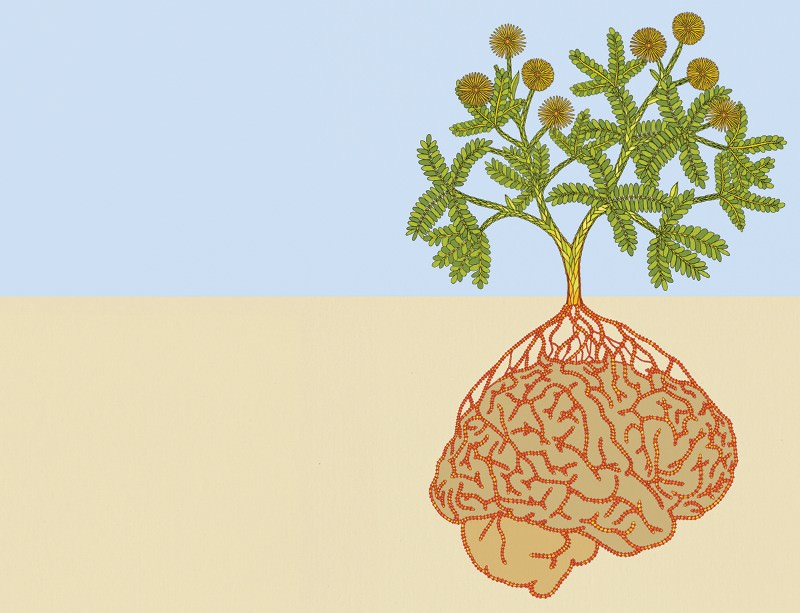
Root intelligence: Plants can think, feel and learn

With an underground "brain network" and the ability to react and remember, plants have their own kind of intelligence – and may even cry out in pain


STEVE SILLETT has been hanging out with giants all his working life. He climbs and studies the canopies of giant redwoods along the coast of northern California. Sometimes, when traversing from the top of one tree to another, he is awestruck by the life that surrounds him. “There’s this awareness of where you are, 90 metres up, in this breathing, living forest of ancient beings,” says Sillett, who is at Humboldt State University, California. “You get into this space where you are interacting with another organism that functions completely differently.”

Had Aristotle hung out among redwoods, he might not have consigned plants to the bottom rungs of his “ladder of life”. But he didn’t, and botanists have been tormented by his legacy. For centuries, few dared challenge his judgement. Now that’s finally changing. In the past decade, researchers have been making the case for taking plants more seriously. They are finding that plants have a sophisticated awareness of their environment and of each other, and can communicate what they sense. There is also evidence that plants have memory, can integrate massive amounts of information and maybe pay attention. Some botanists argue that they are intelligent beings, with a “neurobiology” all of their own. There’s even tentative talk of plant consciousness.

Charles Darwin would have approved. He was the first to seriously question Aristotelian ideas that plants don’t have the stuff of life that animates us and other animals, simply because they don’t move. One of his books, published in 1880, was provocatively titled The Power of Movement in Plants. But despite this patronage, plants didn’t catch the fancy of biologists pondering intelligent life for more than a century.

Roots as brains?


Then, in 1900, Indian biophysicist Jagdish Chandra Bose began a series of experiments that laid the groundwork for what some today call “plant neurobiology”. He argued that plants actively explore their environments, and are capable of learning and modifying their behaviour to suit their purposes. Key to all this, he said, was a plant nervous system. Located primarily in the phloem, the vascular tissue used to transport nutrients, Bose believed this allowed information to travel around the organism via electrical signals.

Bose was also well ahead of his time. It wasn’t until 1992 that his idea of widespread electrical signalling in plants received strong support when researchers discovered that wounding a tomato plant results in a plant-wide production of certain proteins – and the speed of the response could only be due to electrical signals and not chemical signals travelling via the phloem as had been assumed. The door to the study of plant behaviour was opened.

Even then, it would be another decade before Anthony Trewavas at the University of Edinburgh, UK, became the first person to seriously broach the topic of plant intelligence. Trewavas defines intelligence as the ability to sense one’s environment, to process and integrate such sensory perceptions, and decide on how to behave. “The great problem of plant behaviour has always been that you can’t see it going on,” he says. There are a few exceptions, such as the snap of the Venus flytrap. “But the most visible plant behaviour is simply growth, and growth is a very slow business,” he says. This problem has been reduced with the advent of time-lapse video and photography.

Take the parasitic vine Cuscuta, also known as dodder. In time-lapse, a dodder seedling seems to sniff the air looking for a host, and when it finds one, it lunges and wraps itself around its victim. It even shows a preference, choosing tomato over wheat, for example. “It is remarkably snakelike in the way it behaves,” says Trewavas. “You’ll stop doubting that plants aren’t intelligent organisms, because they are behaving in ways that you expect animals to behave.”

Once Trewavas mooted the idea of plant intelligence, others soon backed him up. So much so that in 2005, the Society for Plant Neurobiology was formed to foster debate and change the way we think about plants. “There is a kind of brain chauvinism,” says Stefano Mancuso, one of the founders based at the University of Florence, Italy. “We think that a brain is something that is absolutely needed to have intelligence.” Not so. Despite a lack of neurons and an animal-like nervous system, plants are perfectly capable of processing and integrating information to generate behaviour that can be called intelligent. Mancuso and society co-founder Frantisek Baluska at the University of Bonn, Germany, believe that roots are the key.

A root is a complex assemblage. There’s the root cap, which protects the root as it navigates through soil, but also senses a wide range of physical properties, such as gravity, humidity, light, oxygen and nutrients. Behind this is the meristem, a region of rapidly dividing cells. Further back is the elongation zone, where cells grow in length, allowing the root to lengthen and bend. And between the meristem and the elongation zone is a curious region called the transition zone (see diagram). Traditionally, it was thought to have no purpose, but Baluska and Mancuso think it is actually the nerve centre of the plant.

Underground intelligence

They have found that the transition zone is electrically active. What’s more, within it a hormone called auxin, which regulates plant growth, is ferried around in protein containers called vesicles that are reused once they have released their load. This is similar to the transport of neurotransmitters in animal brains, where vesicle recycling is thought to be important for the efficient and precise information exchange across synapses. The transition zone is also a major consumer of oxygen, in another curious analogy to the human brain. All of which leads Baluska and Mancuso to suggest that this is where sensory information gathered by the root cap is translated into commands for the elongation zone – and so control of root behaviour.

Intriguingly, this ties in with Darwin’s “root brain” hypothesis. In the last paragraph of The Power of Movement in Plants, he dared readers to think of the root as the intelligent end of a plant. Referring to a plant’s primary root, or radicle, he wrote: “It is hardly an exaggeration to say that the tip of the radicle… acts like the brain of one of the lower animals.”
“Intriguingly, the function of the transition zone ties in with Darwin’s ‘root brain’ theory”

“He was right once more,” says Mancuso. “If we need to find an integrative processing part of the plant, we need to look at the roots.”

Parallels with animal intelligence don’t end there. Besides the tantalising brain-like behaviour of the root’s transition zone, many plant cells are capable of neuron-like activity. “In plants, almost every cell is able to produce and propagate electric signals. In roots, every single living cell is able to,” says Mancuso. Likewise, the phloem is extremely electrically active, and capable of fast electrical signalling. “It is some kind of huge axon, running from the shoot tip to the root tip,” says Baluska.

There’s also the curious fact that plants produce chemicals that in animal brains act as hormones and neurotransmitters, such as serotonin, GABA and melatonin. Nobody quite knows the significance of these chemicals in plants – it could simply be that evolution has come up with similar molecules for very different purposes in plants and animals. Nevertheless, Susan Murch of the University of British Columbia in Kelowna, Canada, has shown that drugs like Prozac, Ritalin and methamphetamines, which disrupt neurotransmitters in our brains, can do the same in plants. “If you really mess with a plant’s ability to either transport or make melatonin or serotonin, root development is very strange – they are malformed and disjointed,” she says.

Despite all this, the term “plant neurobiology” is controversial even among some of the most vocal advocates of plants. Daniel Chamovitz at Tel Aviv University in Israel says it’s an oxymoron. “Plants just don’t have neurons. It’s like saying ‘human floral biology’,” he says. Indeed, the Society for Plant Neurobiology met with so much resistance that its founders were forced to change its name to the less controversial Society of Plant Signaling and Behavior.

Nevertheless, Chamovitz and others don’t dispute that plants are extremely aware of their environment, and are able to process and integrate information in sophisticated ways. In fact, a plant’s awareness of its environment is often keener than an animal’s precisely because plants cannot flee from danger and so must sense and adapt to it. For instance, while animals have a handful of photoreceptors to sense light, plants have about 15. “Plants are acutely aware of their environment,” says Chamovitz. “They are aware of the direction of the light and quality of the light. They communicate with each other with chemicals, whether we want to call this taste, or smell, or pheromones. Plants ‘know’ when they are being touched, or when they are being shook by the wind. They integrate all of this information precisely. And they do all of this integration in the absence of a neural system.”

The Venus fly trap remembers a touch and only shuts if touched again within 30 seconds


Plants also manage to remember things without the benefit of neurons. Memory can be defined, according to Chamovitz, as “recording an event, storing that event and recalling it at a later time in order to do something”. And plants certainly do this. For example, just one touch isn’t enough to spring the jaws of a Venus flytrap. Instead, it remembers the first touch and if it senses another within 30 seconds it snaps shut. That’s because the first touch causes molecules to build up in the trap’s sensory hairs and the second touch pushes the concentration of these across a threshold, resulting in an electrical impulse that activates the trap.

There is even evidence that plants have long-term memories. Mimosa pudica, the touch-me-not plant, can close its leaflets when touched, but this defensive behaviour requires energy, therefore the plant doesn’t indulge in it unnecessarily. When Mancuso and colleagues dropped potted mimosas on to foam from a height of 15 centimetres, the plants closed their leaves in response to the fall. But after just four to six drops they stopped doing this – as if they realised that the fall posed no danger. However, they continued to close their leaves in response to a physical touch, which would normally presage being damaged or eaten. “Even after one month, they were able to discriminate and be able to understand whether the stimulus was dangerous or not,” says Mancuso.

This is all very clever, but it’s not intelligence, says Chamovitz: “I don’t like the term plant intelligence. We don’t even know what intelligence is for humans. If you get five psychologists together you will get 20 different definitions.”

Murch agrees. She acknowledges that plants seem to possess the various elements that make intelligence possible – sensing, awareness, integration of information, long-term memory and adaptive learning – but she is not convinced this adds up to intelligence. And despite years spent among towering redwoods, Sillett is also doubtful. “I wouldn’t call it intelligence, but awareness. These trees are keenly aware of their environment, and they respond to it in many ways that we can measure as performance.”

But while many researchers are cautious, others are keen to push the way that we think about plants into even more disputed territory. Baluska suggests that plants may even feel pain, and argues that this is a sign that they have a kind of consciousness. An animal can be knocked out with anaesthetics, including the gas ethylene. Plants produce ethylene to regulate everything from seed germination to fruit ripening. They also release it when stressed – when under attack by predators or being cut by humans, for example – and nearby plants can sense it. “Ethylene is the plant equivalent of a scream,” says Murch. But Baluska goes a step further, pointing out that the gas is produced in large quantities by fruit when it’s ready to be eaten. “If you consider ethylene as an anaesthetic, and if some organism is producing an anaesthetic under stress then you could get ideas that plants maybe feel some pain,” he says.  “Plants may even feel pain, a sign they could have a kind of consciousness”

Such notions are extremely controversial and, even Baluska agrees, speculative. To avoid simply pitting one side against another in the debate, we need a different framework to start thinking about notions of intelligence and consciousness, says Michael Marder of the University of the Basque Country in Vitoria-Gasteiz, Spain. The lone plant philosopher for now, he argues for a phenomenological approach to understanding plants, which involves asking: what does the world look like from the standpoint of plant life?

“Our task is to think about these concepts of attention, consciousness and intelligence in a way that becomes somehow decoupled from the figure of the human,” he says. “I want [us] to rethink the concept of intelligence in such a way that human intelligence, plant intelligence and animal intelligence are different sub-species of that broader concept, which can somehow encompass these different life forms.”

Murch has begun engaging with such questions in one of her classes, which brings together biochemistry and creative writing students to ponder plant intelligence. “Inevitably, there is a vegan in the audience who goes, ‘Then what will I eat?'” she says.

That might seem like a flippant response, but contemplating whether plants are intelligent could lead us to change the way we live. As Marder points out, the sessile nature of plants means they don’t exist in opposition to the place they grow. Rather, they become a focal point for myriad organisms.

“Maybe we can use that model for ourselves, to temper a little bit the excessive separation from our environment that has led in large part to the profound environmental crisis we find ourselves in,” he says.