Thursday, 2 April 2015

Your credulous brain

From New Scientist

Beliefs define our actions and how we perceive the world and make us human. With no beliefs there would be no terrorism, no wars, no economic disasters and no racism. There would also be no cathedrals, no nature reserves, no science and no art. Whatever beliefs we hold, it's impossible to imagine life without them. Beliefs are so natural to us that we rarely stop to think how bizarre the concept of belief really is.
Bertrand Russell describe belief as "the central problem in the analysis of mind". Belief, he said, is "the most 'mental' thing we do" – by which he meant the most removed from the matter that our brains are made of. How can the brain - a physical object - believe things? Philosophers have debated the nature of belief for thousands of years but in recent years science is joining the debate.
"We once thought that human beliefs were too complex to be amenable to science," says Frank Kreuger, a neuroscientist at George Mason University in Fairfax, Virginia. "But that era has passed." A picture of belief is emerging that is different to the common-sense assumptions we have. It turns out we have a lot less control than we feel we have.
Our beliefs come in many shapes and sizes, from the trivial and the easily verified – I believe it will rain today – to profound leaps of faith – I believe in God. Taken together they form a personal guidebook to reality, telling us not just what is factually correct but also what is right and good, and hence how to behave towards one another and the natural world. This makes them arguably not just the most mental thing our brains do but also the most important. "The prime directive of the brain is to extract meaning. Everything else is a slave system," says psychologist Peter Halligan at Cardiff University, UK.
Yet, despite their importance, one of the long-standing problems with studying beliefs is identifying exactly what it is you are trying to understand. "Everyone knows what belief is until you ask them to define it," says Halligan. What is generally agreed is that belief is a bit like knowledge, but more personal. Knowing something is true is different from believing it to be true; knowledge is objective, but belief is subjective. It is this leap-of-faith aspect that gives belief its singular, and troublesome, character.
Philosophers have long argued about the relationship between knowing and believing. In the 17th century, René Descartes and Baruch Spinoza clashed over this issue while trying to explain how we arrive at our beliefs. Descartes thought understanding must come first; only once you have understood something can you weigh it up and decide whether to believe it or not. Spinoza didn't agree. He claimed that to know something is to automatically believe it; only once you have believed something can you un-believe it. The difference may seem trivial but it has major implications for how belief works.
If you were designing a belief-acquisition system from scratch it would probably look like the Cartesian one. Spinoza's view, on the other hand, seems implausible. If the default state of the human brain is to unthinkingly accept what we learn as true, then our common-sense understanding of beliefs as something we reason our way to goes out of the window. Yet, strangely, the evidence seems to support Spinoza. For example, young children are extremely credulous, suggesting that the ability to doubt and reject requires more mental resources than acceptance. Similarly, fatigued or distracted people are more susceptible to persuasion. And when neuroscientists joined the party, their findings added weight to Spinoza's view. 
The neuroscientific investigation of belief 
This began in 2008, when Sam Harris at the University of California, Los Angeles, put people into a brain scanner and asked them whether they believed in various written statements. Some were simple factual propositions, such as "California is larger than Rhode Island"; others were matters of personal belief, such as "There is probably no God". Harris found that statements people believed to be true produced little characteristic brain activity – just a few brief flickers in regions associated with reasoning and emotional reward. In contrast, disbelief produced longer and stronger activation in regions associated with deliberation and decision-making, as if the brain had to work harder to reach a state of disbelief. Statements the volunteers did not believe also activated regions associated with emotion, but in this case pain and disgust.
Harris's results were widely interpreted as further confirmation that the default state of the human brain is to accept. Belief comes easily; doubt takes effort. While this doesn't seem like a smart strategy for navigating the world, it makes sense in the light of evolution. If the sophisticated cognitive systems that underpin belief evolved from more primitive perceptual ones, they would retain many of the basic features of these simpler systems. One of these is the uncritical acceptance of incoming information. This is a good rule when it comes to sensory perception as our senses usually provide reliable information. But it has saddled us with a non-optimal system for assessing more abstract stimuli such as ideas.
Further evidence that this is the case has come from studying how and why belief goes wrong. "When you consider brain damage or psychiatric disorders that produce delusions, you can begin to understand where belief starts," says Halligan. Such delusions include beliefs that seem bizarre to outsiders but completely natural to the person concerned. For example, people sometimes believe that they are dead, that loved ones have been replaced by imposters, or that their thoughts and actions are being controlled by aliens. And, tellingly, such delusions are often accompanied by disorders of perception, emotional processing or "internal monitoring" – knowing, for example, whether you initiated a specific thought or action.
These deficits are where the delusions start, suggests Robyn Langdon of Macquarie University in Sydney, Australia. People with delusions of alien control, for example, often have faulty motor monitoring, so fail to register actions they have initiated as their own. Likewise, people with the delusion known as "mirror-self misidentification" fail to recognise their own reflection. They often also have a sensory deficit called mirror agnosia: they don't "get" reflective surfaces. A mirror looks like a window and if asked to retrieve an object reflected in one they will try to reach into the mirror or around it. Their senses are telling them that the person in the mirror isn't them, and so they believe this to be true. Again, we trust the evidence of our senses, and if they tell us that black is white, we generally do well to believe them.
You may think that you would never be taken in like that but, says Langdon, "we all default to such believing, at least initially". Consider the experience of watching a magic show. Even though you know it's all an illusion, your instinctive reaction is that the magician has altered the laws of physics.
Misperceptions are not delusions, of course. Witnessing someone being sawn in half and put back together doesn't mean we then believe that people can be safely sawn in half. What's more, sensory deficits do not always lead to delusional beliefs. So what else is required? Harris's brain imaging studies delivered an important clue: belief involves both reasoning and emotion.
The feeling of rightness
The formation of delusional belief probably also requires the emotional weighing-up process to be disrupted in some way. It may be that brain injury destroys it altogether, causing people to simply accept the evidence of their senses. Or perhaps it just weakens it, lowering the evidence threshold required to accept a delusional belief.
For example, somebody with a brain injury that disrupts their emotional processing of faces may think "the person who came to see me yesterday looked like my wife, but didn't feel like her, maybe it was an impostor. I will reserve judgement until she comes back." The next meeting feels similarly disconnected, and so the hypothesis is confirmed and the delusion starts to grow.
According to Langdon and others, this is similar to what goes on in the normal process of belief formation. Both involve incoming information together with unconscious reflection on that information until a "feeling of rightness" arrives, and a belief is formed.
This two-stage process could help explain why people without brain damage are also surprisingly susceptible to strange beliefs. Our natural credulity is one thing, and is particularly likely to lead us astray when we are faced with claims based on ideas that are difficult to verify with our senses – "9/11 was an inside job", for example. The second problem is with the "feeling of rightness", which would appear to be extremely fallible.
So where does the feeling of rightness come from? 
The evidence suggests that it has three main sources – our evolved psychology, personal biological differences and the society we keep.
The importance of evolved psychology is illuminated by perhaps the most important belief system of all: religion. Although the specifics vary widely, religious belief per se is remarkably similar across the board. Most religions feature a familiar cast of characters: supernatural agents, life after death, moral directives and answers to existential questions. Why do so many people believe such things so effortlessly?
According to the cognitive by-product theory of religion, their intuitive rightness springs from basic features of human cognition that evolved for other reasons. In particular, we tend to assume that agents cause events. A rustle in the undergrowth could be a predator or it could just be the wind, but it pays to err on the side of caution; our ancestors who assumed agency would have survived longer and had more offspring. Likewise, our psychology has evolved to seek out patterns because this was a useful survival strategy. During the dry season, for example, animals are likely to congregate by a water hole, so that's where you should go hunting. Again, it pays for this system to be overactive.
This potent combination of hypersensitive "agenticity" and "patternicity" has produced a human brain that is primed to see agency and purpose everywhere. And agency and purpose are two of religion's most important features – particularly the idea of an omnipotent but invisible agent that makes things happen and gives meaning to otherwise random events. In this way, humans are naturally receptive to religious claims, and when we first encounter them – typically as children – we unquestioningly accept them. There is a "feeling of rightness" about them that originates deep in our cognitive architecture.
According to Kreuger, all beliefs are acquired in a similar way. "Beliefs are on a spectrum but they all have the same quality. A belief is a belief."
Our agent-seeking and pattern-seeking brain usually serves us well, but it also makes us susceptible to a wide range of weird and irrational beliefs, from the paranormal and supernatural to conspiracy theories, superstitions, extremism and magical thinking. And our evolved psychology underpins other beliefs too, including dualism – viewing the mind and body as separate entities – and a natural tendency to believe that the group we belong to is superior to others.
A second source of rightness is more personal. When it comes to something like political belief, the assumption has been that we reason our way to a particular stance. But, over the past decade or so, it has become clear that political belief is rooted in our basic biology. Conservatives, for example, generally react more fearfully than liberals to threatening images, scoring higher on measures of arousal such as skin conductance and eye-blink rate. This suggests they perceive the world as a more dangerous place and perhaps goes some way to explaining their stance on issues like law and order and national security.
Another biological reflex that has been implicated in political belief is disgust. As a general rule, conservatives are more easily disgusted by stimuli like fart smells and rubbish. And disgust tends to make people of all political persuasions more averse to morally suspect behaviour, though the response is stronger in conservatives. This has been proposed as an explanation for differences of opinion over important issues such as gay marriage and illegal immigration. Conservatives often feel strong revulsion at these violations of the status quo and so judge them to be morally unacceptable. Liberals are less easily disgusted and less likely to judge them so harshly.
Different realities
These instinctive responses are so influential that people with different political beliefs literally come to inhabit different realities. Many studies have found that people's beliefs about controversial issues align with their moral position on it. Supporters of capital punishment, for example, often claim that it deters crime and rarely leads to the execution of innocent people; opponents say the opposite.
That might simply be because we reason our way to our moral positions, weighing up the facts at our disposal before reaching a conclusion. But there is a large and growing body of evidence to suggest that belief works the other way. First we stake out our moral positions, and then mould the facts to fit.
So if our moral positions guide our factual beliefs, where do morals come from? The short answer: not your brain.
According to Jonathan Haidt at the University of Virginia, our moral judgements are usually rapid and intuitive; people jump to conclusions and only later come up with reasons to justify their decision. To see this in action, try confronting someone with a situation that is offensive but harmless, such as using their national flag to clean a toilet. Most will insist this is wrong but fail to come up with a rationale, and fall back on statements like "I can't explain it, I just know it's wrong".
This becomes clear when you ask people questions that include both a moral and factual element, such as: "Is forceful interrogation of terrorist suspects morally wrong, even when it produces useful information?" or "Is distributing condoms as part of a sex-education programme morally wrong, even when it reduces rates of teenage pregnancy and STDs? People who answer "yes" to such questions are also likely to dispute the facts, or produce their own alternative facts to support their belief. Opponents of condom distribution, for example, often state that condoms don't work so distributing them won't do any good anyway.
What feels right to believe is also powerfully shaped by the culture we grow up in. Many of our fundamental beliefs are formed during childhood. According to Kreuger, the process begins as soon as we are born, based initially on sensory perception – that objects fall downwards, for example – and later expands to more abstract ideas and propositions. Not surprisingly, the outcome depends on the beliefs you encounter. "We are social beings. Beliefs are learned from the people you are closest to," says Kreuger. It couldn't be any other way. If we all had to construct a belief system from scratch based on direct experience, we wouldn't get very far.
This isn't simply about proximity; it is also about belonging. Our social nature means that we adopt beliefs as badges of cultural identity. This is often seen with hot-potato issues, where belonging to the right tribe can be more important than being on the right side of the evidence. Acceptance of climate change, for example, has become a shibboleth in the US – conservatives on one side, liberals on the other. Evolution, vaccination and others are similarly divisive issues.
So, what we come to believe is shaped to a large extent by our culture, biology and psychology. By the time we reach adulthood, we tend to have a relatively coherent and resilient set of beliefs that stay with us for the rest of our lives. These form an interconnected belief system with a relatively high level of internal consistency. But the idea that this is the product of rational, conscious choices is highly debatable. "If I'm totally honest I didn't really choose my beliefs: I discover I have them," says Halligan. "I sometimes reflect upon them, but I struggle to look back and say, what was the genesis of this belief?"
Forget the facts
The upshot of all this is that our personal guidebook of beliefs is both built on sand and also highly resistant to change. "If you hear a new thing, you try to fit it in with your current beliefs," says Halligan. That often means going to great lengths to reject something that contradicts your position, or seeking out further information to confirm what you already believe.
That's not to say that people's beliefs cannot change. Presented with enough contradictory information, we can and do change our minds. Many atheists, for example, reason their way to irreligion. Often, though, rationality doesn't even triumph here. Instead, we are more likely to change our beliefs in response to a compelling moral argument – and when we do, we reshape the facts to fit with our new belief. More often than not, though, we simply cling to our beliefs.
All told, the uncomfortable conclusion is that some if not all of our fundamental beliefs about the world are based not on facts and reason – or even misinformation – but on gut feelings that arise from our evolved psychology, basic biology and culture. The results of this are plain to see: political deadlock, religious strife, evidence-free policy-making and a bottomless pit of mumbo jumbo. Even worse, the deep roots of our troubles are largely invisible to us. "If you hold a belief, by definition you hold it to be true," says Halligan. "Can you step outside your beliefs? I'm not sure you'd be capable."
The world would be a boring place if we all believed the same things. But it would surely be a better one if we all stopped believing in our beliefs quite so strongly.

Wednesday, 25 March 2015

Me Myself and iCub - The Robot with a Self

From New Scientist 


The human self has five components. Machines now have three of them. How far away is artificial consciousness – and what does it tell us about ourselves?


What is the self? Rene Descartes encapsulated one idea of it in the 1600s when he wrote: "I think, therefore I am". He saw his self as a constant, the essence of his being, on which his knowledge of everything else was built. Others have very different views. Writing a century later, David Hume argued that there was no "simple and continued" self, just the flow of experience. Hume's proposal resonates with the Buddhist concept anatta, or non-self, which contends that the idea of an unchanging self is an illusion and also at the root of much of our unhappiness.

Today, a growing number of philosophers and psychologists hold that the self is an illusion. But even if the centuries-old idea of it as essential and unchanging is misleading, there is still much to explain, for example: how you distinguish your body from the rest of the world; why you experience the world from a specific perspective, typically somewhere in the middle of your head; how you remember yourself in the past or imagine yourself in the future; and how you are able to conceive of the world from another's point of view. I believe that science is close to answering many of these questions.

Can we learn about being human from a robot? 

A key insight is that the self should be considered not as an essence, but as a set of processes – a process being a virtual machine running inside a physical one, as when a program runs on a computer. Likewise, some patterns of brain activity constitute processes that generate the human self. This fits with Hume's intuition that if you stop thinking, the self vanishes. For instance, when you fall asleep, "you", the entity brought into being by a set of active brain processes, cease to exist. However, when you awake, those same processes pick up much where they left off, providing subjective continuity.

The idea that the self emerges from a set of processes has encouraged my colleagues and I to believe we can recreate it in a robot. By deconstructing it and then attempting to build it up again piece by piece, we are learning more about what selfhood is. This is an on-going collaboration with researchers in several European institutes, and admittedly we still have a way to go. But I'm confident we can create an artificial self, or at least as much of one as would be wise. We believe our work will help resolve the mystery at the heart of selfMovie Camera – that it feels compellingly real, yet, when examined closely, seems to dissolve away.

iCub

Meet iCub (see video at top of page), the state-of-the-art humanoid robot in which we are creating this sense of self. This bot has vision, hearing, touch and a proprioceptive sense that allows it to coordinate its 53 joints. It can speak and interact with its world, and it improves its performance by learning. There are currently 30 such robots in research labs around the world. At Sheffield Robotics, our iCub has a control system modelled on the brain, so that it "thinks" in ways similar to you and me. For the past four years, we have been working to give this robot a sense of self.

We first had to consider exactly how we might deconstruct selfhood in order to build it in a machine. Philosophy, psychology and neuroscience give many insights into what constitutes the human self, and how to recognise and measure aspects of it in adults, infants and even animals. Our attempt begins with psychology, but can also be mapped on to a growing understanding of how the psychological self emerges from brain activity.

William James, a founder of modern psychology, suggested that the self can be divided into "I" and "me" – the former comprising the experience of being a self, the latter the set of ideas you have about your self. In the 1990s, psychologist Ulric Neisser, a pioneer of modern cognitive psychology, went further. He identified five key aspects of self: the ecological or physically situated self, the interpersonal self, the temporally extended self, the conceptual self and the private self (see "Aspects of self"). Neisser's analysis is not the final word, but it is grounded in an understanding of human cognitive development, whereas classical philosophical views such as those of Hume and Descartes were not. It has also provided useful clues about what might be required to build up an artificial self, process-by-process.

How have we gone about creating these processes for our robot? We use an approach called neurorobotics, which means we incorporate knowledge about how real brains work into our programming. So our iCub's control system is designed to emulate key processes found in the mammalian brain. The interactions between these processes are governed by an architecture called distributed adaptive control, developed by my colleague Paul Verschure at the Catalan Institution for Research and Advanced Studies in Barcelona, Spain. This system is modelled on the cognitive architecture of the brain.

Motor babbling

Now, say we want to start building a process that emulates the human ecological self. Key to this is an awareness of one's body and how it interacts with the world. For iCub to achieve this, it needs an internal "body schema" – a process that maintains a model of its physical parts and its current body pose. Rather than programming the body schema directly, as other roboticists might do, we have given iCub the capacity to work it out. It learns by generating small, random movements and observing the consequences these have. Human babies show a similar kind of exploratory behaviour – termed motor babbling – in the womb and in early infancy, suggesting that people learn about their bodies in much the same way.

Using this approach, Giorgio Metta and colleagues at the Italian Institute of Technology in Genoa, Italy, are training our iCub to distinguish self from other, a fundamental aspect of the ecological self. The motor babbling program also allows the robot to learn how to achieve a specific target pose. Combining this body model with knowledge of objects and surfaces nearby enables iCub to move around without colliding with things.

Then there's the temporally extended self. Insights about this can be found in the case of a man we will call N.N., who lost the ability to form long-term memories after an accident in the 1980s. The damage to his brain also left him completely without foresight. He described trying to imagine his future as "like swimming in the middle of a lake. There is nothing there to hold you up or do anything with." In losing his past, N.N. had also lost his future. His ecological self remained intact, but it had become marooned in the present.

This concept of time also poses a problem for our robot. Although we can channel all its sensory input into a hard drive, iCub must also be able to decide how best to use the information to make sense of the present. Peter Dominey and his group at the French Institute of Health and Medical Research in Lyon, have addressed this problem. They have encoded iCub's interactions with objects and people in a way that allows it to more clearly see their relevance to present situations. However, this model uses standard computing techniques, so we are working with them to create a neurorobotic version. It will directly emulate processing in brain areas, such as the hippocampus, that are known to play a role in creating human autobiographical memory.

Recent brain imaging studies have confirmed what we learned from N.N.'s experience: that the same brain systems underlie our ability to recall past events as well as imagine what the future might bring. Our hope is that a model of the temporal self will provide iCub with contextual information from the past that will help it to better understand its current experience. This, in turn, should improve its ability to predict what could happen next.

Thinking about self as a set of processes, it becomes clear that some of these are connected. For example, a key aspect of the interpersonal self is empathy, which derives from a general ability to imagine oneself in another's shoes. One way humans might do this is to internally simulate what they perceive to be the another's situation, using the model that underlies their own ecological self. So the interpersonal self could grow out of the ecological self. But what more is needed? We consider an important building block to be the capacity to learn by imitation.

Your ability to interpret another person's actions using your own body schema is partly down to mirror neurons – cells in your brain that fire when you perform a given movement and when you see someone else perform it. Using this insight, Yiannis Demiris at Imperial College London has extended iCub's motor babbling program into an imitation learning system. As a result, iCub can rapidly acquire new hand gestures, and learn sequences of actions involved in playing games or solving puzzles, simply by watching people perform these tasks. The system will have to be extended further to achieve empathy, so that iCub recognises and mirrors a person's emotional state as well as their movement.

There is still plenty to do. Our models of the ecological, interpersonal and temporal selves are undoubtedly crude in comparison to what goes on in human brains. And we have yet to tackle the conceptual and private selves that would provide iCub with knowledge of what –or who – it is, and an awareness that it has an internal world not shared by others.

When we meet the challenge of making iCub's self processes more realistic, there may be some aspects of the human version that we will not want to emulate. For example, the robot's motivations and goals are essentially those we design in, and it might be wise to leave things that way, rather than allow them to evolve as they do in people.

Something else holding us back is iCub's limited understanding of language. Although our robot can recognise speech, this is not the same as understanding meaning – that requires relating words to action and objects. Our colleagues in Lyon are working on a neurorobotic solution to this problem but, for the moment, iCub is only capable of two-way conversations on a few topics, such as the game it is currently playing with you.

That said, we can see the practical potential of robots of this kind. An ecological self makes our iCub safer to be around. The temporally extended self allows it to remember the past and anticipate the future. The interpersonal self means it can conceive of, and anticipate, human needs and actions. Such a robot could work alongside people in fields from manufacturing and search-and-rescue to helping care for people with disabilities.

You might argue that our models have missed a crucial element: the "I" at the centre of James' notion of self – what we also call consciousness. But one possibility is that this arises when the other aspects of self are brought together. In other words, it may be an emergent property of a suitably configured set of self processes, rather than a distinct thing in itself. Returning to the Buddhist idea of the self as an illusion, when you strip away the different component processes, perhaps there will be nothing left.

But is it a person?

Our idea of the self is intimately tied up with our notion of what it means to be a person. Is it conceivable, then, that one day we might attribute personhood to a robot with an artificial sense of self? In the 17th century, philosopher John Locke defined a person as an entity with reason and language, possessing mental states such as beliefs, desires and intentions, capable of relationships and morally responsible for its actions. Modern philosopher Daniel Dennett at Tufts University in Boston largely agrees, but with an important addition. A person, he says, is someone who is treated as a person by others. So we grant personhood to one another.

Note that neither Locke nor Dennett specify that a person is made of biological stuff. Even so, at this stage, our iCub falls short of the criteria required. It can reason, use language, have beliefs and intentions, and enter into relationships of a kind. We might even be inclined to judge it for the appropriateness of its actions. However, it does not yet have the full set of processes associated with a human self, so we cannot be sure that its mental states are anything like ours. Neither is it a moral being – not as we commonly think of them – because it does not base its choices on values.

Be that as it may, our everyday attribution of personhood is grounded more in direct impressions than a philosophical checklist. As Dennett says, personhood is partly in the eyes of the beholder. And, when interacting with iCub, it can feel natural to behave towards this robot as though we are taking the first steps in creating a new kind of person. Sometimes it even leaves me with the surprising feeling that "someone is home".

Aspects of self

Psychologist Ulric Neisser's multifaceted description of the self provides useful targets for a robot to emulate

Ecological self
Having a point of view; distinguishing yourself from others; having a feeling of body ownership

Interpersonal self
Self-recognition (e.g. in a mirror); seeing others as agents like you; having empathy for others

Temporally extended self
Having awareness of your personal past and future

Conceptual self
Having an idea of who you are; having a life story, personal goals, motivations and values

Private self
Having a stream of consciousness; knowing you have an inner life

What is Intelligence?


1 What is Intelligence?

The most succinct definition of intelligence is the ability to solve problems. But to be more precise it can be defined as 
a very general mental capability that, among other things, involves the ability to reason, plan, solve problems, think abstractly, comprehend complex ideas, learn quickly and learn from experience. It is not merely book learning, a narrow academic skill, or test-taking smarts. Rather, it reflects a broader and deeper capability for comprehending our surroundings - "catching on," "making sense" of things, or "figuring out" what to do."
 From New Scientist

2 IQ Tests - What are the measuring? 

A century ago, psychologist Charles Spearman observed that individuals who do well on one mental test tend to do well on all types of mental tests.  He reasoned that all tests must therefore tap into some deeper, general ability and he invented a statistical method called factor analysis to extract this common factor from correlations across all tests. He defined a general factor of intelligence known as the "g factor".  In essence, g equates to an individual's ability to deal with cognitive complexity.


In the 1970s psychologist Arthur Jensen discovered that g aligns with diverse features of the brain, from relative size to processing speed. In all human groups - and in other species too - most cognitive variation comes from variation in g.

So, g operates as a proficiency at mentally manipulating information, which facilitates learning, reasoning, and solving problems.  At the physiological level, differences in g reflect differences in the brain's overall efficiency or integrity. The genetic roots of g are emerging from the joint actions of hundreds if not thousands of genes, themselves responding to different environments.

Having a high g rating is useful, but not a virtue. It is especially handy when one is faced with complex tasks, but it is also associated with lower rates of health-damaging behaviour, chronic illness, post-traumatic stress disorder, Alzheimer's and premature death. A high g helps an individual get ahead socioeconomically, but it has little connection with emotional well-being or happiness. Neither does it correlate with conscientiousness, which is a big factor in whether someone fulfils their intellectual potential.

3 Quantifying intelligence

In 1904, Alfred Binet developed the IQ test to find a practical way to identify children who needed support in elementary school. The test consisted of 30 short, objective questions on tasks such as naming an everyday object and identifying the heavier of two items. His invention worked and spawned massive intelligence-testing programmes on both sides of the Atlantic, used to test applicants for jobs, military recruits, college applicants etc. 

The most comprehensive IQ tests combine scores from areas such as comprehension, vocabulary and reasoning to give an overall IQ. IQ tests are the most technically sophisticated of all psychological tests and undergo the most extensive quality checks before publication. 

Intelligence tests are calibrated so that, at each age, the IQ average score is 100 and 90 per cent of individuals score between IQ 75 and 125. The typical IQ difference between strangers is 17 points and it is 12 between full siblings. So what makes some people smarter than others? And how can we change our score?

4 Older and wiser 

The brain is a physical organ and no less subject than any other to ageing, illness and injury. Normally, the aptitude for learning and reasoning increases quickly in youth, peaks in early adulthood, and then declines slowly thereafter and drops precipitously before death. The good news is that some important abilities resist the downturn.

Some IQ researchers distinguish between tests of fluid intelligence (gF) and crystallised intelligence (gC). The first assess on-the-spot learning, reasoning and problem solving; the second assess the crystallised fruits of our previous intellectual endeavours, such as vocabulary in one's native language and broad cultural knowledge. During youth, gF and gC rise in tandem, but they follow different trajectories thereafter. All gF abilities decline together, perhaps because the brain's processing speed slows down with age. However, most people's gC abilities remain near their personal peak into old age because they reside in the neural connections that gF has laid down over a lifetime of learning and practice. Of course, age-related memory loss will affect an individual's ability to recall, but exactly how this affects intelligence is not yet known.

This has practical implications. On the positive side, robust levels of gC buffer the effects of declining gF. Older workers are generally less able to solve novel problems, but they can often compensate by calling upon their larger stores of experience, knowledge and hard-won wisdom. But gC can also disguise declines in gF, with potentially hazardous results. For example, health problems in later life can present new cognitive challenges, such as complex treatments and medication regimes, which individuals with ample gC may appear to understand when actually they cannot cope.

There are ways of slowing or reversing losses in cognitive function. The most effective discovered so far is physical exercise, which protects the brain by protecting the body's cardiovascular health. Mental exercise, often called brain training, is widely promoted, but it boosts only the particular skill that is practised – its narrow impact mirroring that of educational interventions at other ages. Various drugs are being investigated for their value in staving off normal cognitive decline, but for now preventive maintenance is still the best bet – avoid smoking, drinking to excess, and head injuries.

5 Nature and nurture 

Each of us is the embodiment of our genes and the environment working together from conception to death. To understand how these two forces interact to generate differences in intelligence, behavioural geneticists compare twins, adoptees and other family members. The most compelling research comes from identical twins adopted into different homes – individuals with identical genes but different environments – and non-kin adopted into the same home – unrelated individuals sharing the same environment. These and other studies show that IQ similarity most closely lines up with genetic similarity.

More intriguingly, the studies also reveal that the heritability of intelligence – the variation due to genes – steadily increases with age. Heritability is less than 30 per cent before children start school, rising to 80 per cent among western adults. In fact, by adolescence, separated identical twins answer IQ tests almost as if they were the same person and adoptees in the same household as if they were strangers.

Surprisingly, most family environments are equally effective for nurturing intelligence – the IQ of an adult will be the same almost regardless of where he or she grew up, unless the environment is particularly inhumane. Studies on the nature of nurture offer a clue as to why this is. All children enter the world as active shapers of their own environment. Parents and teachers experience this as their charges frustrate attempts to be shaped in particular ways. And increasing independence gives young people ever more opportunities to choose the cognitive complexity of the environments they seek out. The genetically brighter an individual, the more cognitively demanding the tasks and situations they tend to choose, and the more opportunities they have to reinforce their cognitive abilities.

Given that an individual's ability to exploit a given environment is influenced by their genetic endowment, and given that "better" family environments tend not to produce overall increases in IQ, it is not surprising that attempts to raise low IQs by enriching poor school or home environments tend to disappoint. Narrow abilities can be trained up, but g apparently cannot. This makes sense if g is an overall property of the brain. That does not mean intensive early educational interventions lack positive effects: among other things they may reduce rates of teenage pregnancy, delinquency and school dropout. Besides, even if we cannot boost low intelligence into the average range, we do know how to help all children learn more than they currently do and achieve more with the intelligence they have.

6 Different types of intelligence

Consider the engineer's superior spatial intelligence and the lawyer's command of words and you have to wonder whether there are different types of intelligence. This question was debated ferociously during the early decades of the 20th century. Charles Spearman, on one side, defended the omnipotence of his general factor of intelligence, g. On the other, psychologist Louis Thurstone argued for seven "primary abilities", including verbal comprehension (in which females excel) and spatial visualisation (in which males excel). Thurstone eventually conceded that all his primary abilities were suffused with the same g factor, while Spearman came to accept that there are multiple subsidiary abilities in addition to g on which individuals differ.

This one-plus-many resolution was not widely accepted until 1993, however. It was then that American psychologist John B. Carroll published his "three stratum theory" based on a monumental reanalysis of all factor analysis studies of intelligence. 

At the top is a single universal ability, g. Below this indivisible g are eight broad abilities, all composed mostly of g but each also containing a different "additive" that boosts performance in some broad domain such as visual perception or processing speed. These in turn contribute to dozens of narrower abilities, each a complex composite of g, plus additives from the second level, together with life experiences and specialised aptitudes such as spatial scanning.

This structure makes sense of the many differences in ability between individuals without contradicting the dominance of g. For example, an excellent engineer might have exceptional visuospatial perception together with training to develop specialist abilities, but above all a high standing on the g factor. The one-plus-many idea also exposes the implausibility of multiple-intelligence theories eagerly adopted by educators in the 1980s, which claimed that by tailoring lessons to suit the individual's specific strength – visual, tactile or whatever – all children can be highly intelligent in some way.

7 Physical Attributes of the brain

How is intelligence affected by the brain's physiology? 

7.1 Brain Mass 

It was once thought that a heavier brain means higher intelligence because it would have more neurones ("grey matter") and axons (white matter). However, "more" doesn't mean "better" as shown by the Kleiber's Law diagram, in which humans are at the apex of intelligence. Further increase in brain mass entails more increase in body weight such that the add-on brain cells are allocated for neural housekeeping chores (such as controlling more muscle fibres) unrelated to intelligence.


7.2 Neural Connections

The human brain contains about 120 billion neuronal cells, with an approximately equal number of non-neuronal cells (glial cells). These cells pass signals to each other via as many as 1000 trillion synaptic connections. The communication networks (at about 2% of our body weight) consume about 20% of the energy that we expend at rest. In newborns, it is an astounding 65% so infants rely on parental care for survival. Further increase in neural connections will demand more resource at the expense of the other biological processes in our body.

7.3 Transmission Time

The transmission time between neurones depends on the travelling distance. That's why the motion of elephants appears to be rather slow. The transmission time is also determined by the speed of the signal. It is found that thicker axons carry signals faster. This advantage is negated by greater consumption of energy and occupies more space (the same trade-off as for more neural connections).

7.4 Neurone Density

It was discovered recently that unlike other mammals, cortical neurones in primates enlarge very little as the brain increases in size. This kind of packing strategy allows for a greater number of cortical cell as brains enlarge; and it also permits faster communication, because the cells pack more closely. However, thermal motion triggers random firing of the action potential if the axons or neurones become too small.


7.5 Evolutionary Limits

Restricted by the above-mentioned constraints, it is doubtful that a major evolutionary leap could lead to a smarter brain. The evolution of brains started about 600 million years ago. Since then all kinds of animals have now evolved to a point where the brain circuits have arrived at a similar design for running tasks such as vision, smell, navigation, etc. Such evolutionary convergence usually suggests that a certain anatomical or physiological solution has reached maturity so that there may be little room left for improvement. If our brains were bigger, we would think slower and too much energy would be required. If our brains had increased neural connections or faster transmission times, it would again cost too much energy. And if our neurone density increased, the transmission signals would be too noisy.  


Sunday, 15 March 2015

Absolute Certainty

A Christian Apologist argues against absolute certainty when it comes to believing in God - And I agree with him.


JimC says...

Socrates always made it cleat that any of his views on the supernatural could be wrong. And that resonated with me.


Christian Apologist says...

I don't know of anyone here who doesn't acknowledge that his/her understanding of anything and everything could be wrong

JimC says... 
A survey by the Pew forum in 2013 revealed that 90% of Evangelical Christians, Mormons and Jehovah's Witnesses in the USA are absolutely certain in the existence of God or a universal spirit.

Some typical statements from Evangelical Christians in that 90%...

“So, is there a God? Yes, there is. He is specifically revealed to us in the Bible and more specifically in the person of Jesus Christ.”

“I know that God is real because He has revealed Himself to us. I know that He created the World and me”

“I know that God is real because I have had things happen in my life that are not simply "coincidence.”

“I know that God is real because He speaks to me. He doesn't speak to me with His own voice, though I'm sure He has one.”

"We know that God is real because He has revealed Himself to us in three ways: in creation, in His Word, and in His Son, Jesus Christ."

You seem to represent the other 10% with your statement that...

"our understanding of anything and everything could be wrong" 

So who is right – the 90% of Evangelicals who have absolute certainty, or the 10% like yourself who have an element of doubt?


Christian Apologist says...
There will always need to be a faith element. One would need to converse with those who apparently claim "absolute" certainty to understand the basis for their claims.

JimC says...
I think it would be difficult to "converse" with 75 million people to "understand the reasons for their claims" but we can at least read what they say their reasons for absolute certainty are, such as... "I know that God is real because He has revealed Himself to us." 

Christian Apologist says...
I can only offer my perspective. I don't presume to pre-judge anyone's intentions or reasoning processes on the matter. Again, we would need to hear from those who do claim certainty regarding God's existence to know how they came to their conclusions.

JimC says...
I wonder how you would respond to a Christian who asserted that... "We know that God is real because He has revealed Himself to us in three ways: in creation, in His Word, and in His Son, Jesus Christ." Would you tell them that their understanding could be wrong?

Christian Apologist says...
I wouldn't tell them anything--I'd ask for clarification.

JimC says...
I assume you would tell them they could be wrong (because as you've said previously, anything and everything could be wrong - correct?)

Christian Apologist says...
Pick any specific points you might choose - from you or me. Anything you or I believe might be wrong. In the case of Christians, in fact, such is required--otherwise there would be no such thing as faith.

"Our knowledge is imperfect and our prophesying is imperfect. When the perfect comes, the imperfect will pass away." [ 1Corinthians 13:9-10]


Friday, 13 March 2015

Determinism

A Christian Apologist insists I am a "rigid determinist" because I consider free will to be an illusion. If a label is required to define my views on free will then I would suggest "compatibilist" or "probabilist".  But then again, there are many types of determinism.

I will start by trying to summarise my perspective on determinism. Eventually I will expand this to provide an overview of types of determinism...  

1 Summary 

I don't believe the universe is deterministic because I believe (a) not everything that happens is completely determined by prior events and (b) there are multiple (perhaps infinite) possible futures. So for example, if it were possible to rewind the universe back to its original state and restart the Big Bang process, we would end up with a different, albeit similar, universe.

However it is a fact that many events can be predicted, but only to a certain level of probability - the weather is a good example which I will use later, as I don't think anyone would suggest the weather has free-will.   So rather than seeing the universe as deterministic, I think a better word is probabilistic.  However, any discussion on determinism is complicated because there are many types of determinism and I will discuss those later.

So let's apply this to what we know of the brain. Empirical evidence shows that moments before we are aware of what we will do next, our brain has already determined what we will do. We then become conscious of this “decision” and believe that we are in the process of making it.  So the brain determines what we will do, but the brain is not "deterministic" because we can't predict with certainty what decision it will come to - the decision the brain makes can't be completely determined by prior events. Influenced, yes, but not determined.    Maybe my brain will cause me to eat that delicious hot fudge sundae on the menu, maybe it won't.  All we do know is that the decision, whatever it is, was made by my brain before I was conscious of the decision.   

A Religious Apologist might argue that if brain processes can be described by biology and chemistry then they must be deterministic because the actions of atoms and molecules can be absolutely determined. In fact they can't, because we know the subatomic world is probabilistic. The Religious apologist might then argue that the weather and the brain appear to be probabilistic but that's just because they are very complex.  It would then follow that in the distant, deterministic future,  an "omniscient" computer could be built which will be able to predict the weather across the planet for years into the future, and therefore a similar computer could determine a person's actions from when they are born to the day they die just by calculating the trajectory of their molecules.  I don't think any of that is possible because it is not just the complexity that makes determination of events difficult. The real reason is that at the most fundamental level, physical processes are subject to quantum-mechanical unpredictability and randomness, whether it's in the brain or in DNA or in the planet's atmosphere.  

So now randomness has entered the explanation, does that mean our thoughts would have to be random if they are the result of probabilistic, sub-atomic processes? No it doesn't. The inherent quantum randomness of matter results in probable outcomes, not random outcomes.  A good analogy is a lottery where the jackpot winner picks 6 number between 1 and 49. The chances of winning are 14 million to one - which is almost zero. But every week, at least one person wins on average, because over 14 million tickets are sold. 

If we know a lot about someone's life and history and experiences, and if we have studied what they've said and what they believe, and if they are of sound mind, then we can make a good assessment of how they will behave and the choices they will make - but not with 100% certainty.  When we say we "know how someone thinks", we are assessing how their brains are "programmed".  But the brain is "re-programmed" every second of every day so although we can make a good guess as to whether they will, for example, eat a hot fudge sundae within the next 10 minutes, perhaps they will experience something tomorrow which will put them off hot fudge sundaes for the rest of their lives. 

2 The definition of determinism 

For this I turn to the excellent book "Free Will: The Scandal in Philosophy" by Bob Doyle. 


"Determinism is the idea that everything that happens, including all human actions, is completely determined by prior events.  There is only one possible future, and it is completely predictable in principle, most famously by Laplace’s Supreme intelligent Demon, assuming perfect knowledge of the positions, velocities, and forces for all the atoms in the void.
More strictly, I strongly suggest that determinism should be distinguished from pre-determinism, the idea that the entire past (as well as the future) was determined at the origin of the universe. 
Determinism is sometimes confused with causality, the idea that all events have causes. Despite Hume’s critical attack on the necessity of causes, and despite compatibilists’ great respect for Hume as the modern founder of compatibilism, many philosophers embrace causality and determinism very strongly.
Some even connect it to the very possibility of logic and reason. And Hume himself believed strongly, if inconsistently in necessity. “‘tis impossible to admit any medium betwixt chance and necessity” he said.  Bertrand Russell said “The law of causation, according to which later events can theoretically be predicted by means of earlier events, has often been held to be a priori, a necessity of thought, a category without which science would not be possible.”  
But some events may themselves not be completely determined by prior events. This does not mean they are without causes, just that their causes are probabilistic. Such an event is then indeterminate. It might or might not have happened. It is sometimes called a “causa sui" or self-caused event. But a probabilistically caused event may in turn be the adequately deterministic cause for following events. These later events would therefore not be predictable from conditions before the uncaused event. We call this “soft” causality. Events are still caused, but they are not always predictable or completely pre-determined."
3 Types of Determinism

Again, from the excellent book "Free Will: The Scandal in Philosophy" by Bob Doyle. 


Actualism is the idea that only whatever actually happens could ever have happened. It denies the existence of alternative possibilities for actions. This idea began with the logical sophistry of Diodorus Cronus’ Master Argument for determinism. Statements about a future event that are true today necessitate the future event.

Sophisticated defenses of this idea include the so-called Frankfurt cases, which claim that an agent’s actions can be free even if a hypothetical intervening controller can change the agent's decisions, preventing any alternative possibilities that might have appeared as what John Martin Fischer calls “flickers of free-dom”.

Behavioral Determinism assumes that our actions are reflex reactions developed in us by environmental or operant conditioning. This is the Nurture side of the famous Nature/‘Nurture debate - note that both are determinisms. This view was developed to an extreme by B. F. Skinner in the early 20th century, who had great success “programming” the behaviors of animals, but never with perfect control of behavior. Many cognitive scientists are behaviorists who see the mind as a computer that has been programmed, by accident or deliberately, by education, for example.

Biological Determinism finds causes for our actions in our genetic makeup. This is the Nature side of the Nature/Nurture debate. Again, both sides are determinisms. There is little doubt that our genes pre-dispose us to certain kinds of behavior. But note that our genes contain a minuscule fraction of the information required to determine our futures. Most of the information in the adult brain is acquired through life experiences.

Causal Determinism assumes that every event has an antecedent cause, in an infinite causal chain going back to Aristotle’s Prime Mover. Nothing is uncaused or self-caused (causa sui). Galen Sttrawson supports this view with his Basic Argument. Note that there are always multiple causes for any event. Basically,
all the events that are in the past light-cone of an event can have a causal relationship with the event. 

Cognitive Science Determinism results from a computational model of mind that sees the mind as a computer. The mind may be evolving its own computer programs, but the overall process is completely pre-determined, say cognitive scientists, and philosophers like Daniel Dennett.

Fatalism is the simple idea that everything is fated to happen, so that humans have no control over their future. Notice that fate might be an arbitrary power and need not follow any causal or otherwise deterministic laws. It can thus include the miracles of omnipotent gods, and thus be a theological fatalism. Some philosophers use the term fatalism loosely to cover other determinisms. Richard Taylor’s well-known article, Fatalism, in the Philosophical Review was about logical arguments denying future contingency. The Idle Argument claimed that since things are fated, it is “idle” to take any actions at all, since they can have no effect. 

Historical Determinism is the dialectical idealism of Hegel or the dialectical materialism of Marx that are assumed to govern the course of future history. Marxists have often felt they could revise the past to suit their purposes, but claimed that the future is economically determined.

Logical Determinism reasons that a statement about a future event happening is either true or it is not true. This is the Principle of Bivalence and the Law of the Excluded Middle. lf the statement is true, logical certainty then necessitates the event. Aristotle’s Sea Battle and Diodorus Cronus’ Master Argument are the classical examples of this kind of determinism. If the statement about the future is false, the event it describes can not possibly happen. In logic, as in other formal systems, truth is outside of time, like the foreknowledge of God. Fortunately, logic can constrain our reasoning, but it cannot provide us with knowledge about the physical world nor can it constrain the world.

Linguistic Determinism claims that our language determines (at least limits) the things we can think and say and thus know. The Sapir-Whorf hypothesis claims that speech patterns in a language community constrain the conceptual categories of a linguistic community and thus determine thought.              

Mechanical Determinism explains man as a machine. If Newton’s laws of classical mechanics govern the workings of the planets. stars, and galaxies, goes the argument, surely they govern man the same way. Note that although Rene Descartes described human bodies and all animals as deterministic machines, he said that the human mind was free and undetermined (indetermiriata).

Necessitarianism is a variation of logical and causal determinism that claims everything is simply necessary. This was Leucipus’ view at the beginning of determinism. This was the most popular name for determinists in the 18"‘ century, when they were opposed to libertarians.

Neuroscientific Determinism assumes that the neurons are the originators of our actions. “My neurons made me do it.” The Libet experiments have been interpreted to show that decisions are made by the brain’s neurons significantly before any action of conscious will.

Nomological Determinism is a broad term to cover determinism by laws, of nature, of human nature, etc.

Physical Determinism extends the laws of physics to every atom in the human mind and assumes that the mind will some day be perfectly predictable, once enough measurements are made. The paradigmatic case is that of Laplace’s Demon. Knowing the positions, velocities, and forces acting on every particle in the world, the demon can know the entire past and future. All times are visible to such a super intelligence.

Psychological Determinism is the idea that our actions must be determined by the best possible reason or our greatest desire. Otherwise, our acts would be irrational. Since all the possible actions are presented to the mind, determined by prior actions, the choice is not really made by the agent.

Pre-determinism claims that everything that ever happens was pre-determined at the beginning of the universe. Theological predestination is similar, but if God is assumed to be omnipotent, the events may have been pre-destined more recently. Some theologians insist that God is unchanging and outside of time, in which case predestination reduces to pre-determinism.

Religious or Theological Determinism is the consequence of the presumed omniscience of God. God has foreknowledge of all events. All times are equally present to the eye of God (Aquinas’ totem simul). Note the multiple logical inconsistencies in the idea of an omnipotent, omniscient, benevolent God. If God knows the future, he obviously lacks the power to change it. And if benevolence is assumed, it leads to the problem of evil.

Spatio-temporal Determinism is a view based on special relativity. The “block universe” of Hermann Minkowski and Albert Einstein is taken to imply that time is simply a fourth dimension that already exists, just like the spatial dimensions. The one possible future is already out there, up ahead of where we are now, just like the city blocks to our left and right. J.J.C. Smart is a philosopher who holds this view. He calls himself “somewhat of a fatalist."

Finally, Compatibilism is the idea that Free Will is compatible with Determinism. Compatibilists believe that as long as our Mind is one cause in the causal chain then we can be responsible for our actions, which is reasonable. But they think every cause, including our decisions, are pre-determined. Compatibilists are Determinists. Although some modern compatibilists say they are agnostic on the truth of determinism (and indeterminism).

Some of these determinisms (behavioral, biological, historical-economic, language, and psychological) have demonstrable evidence that they do in fact constrain behaviors and thus limit human freedom. But others are merely dogmas of determinism, believed primarily for the simple reason that they eliminate random chance in the universe.

Chance is anathema to most philosophers and many scientists. But without indeterminacy, there are simply no possibilities for the world to be different from what these many determinisms claim that it will be. 

4 Taxonomy of Determinism

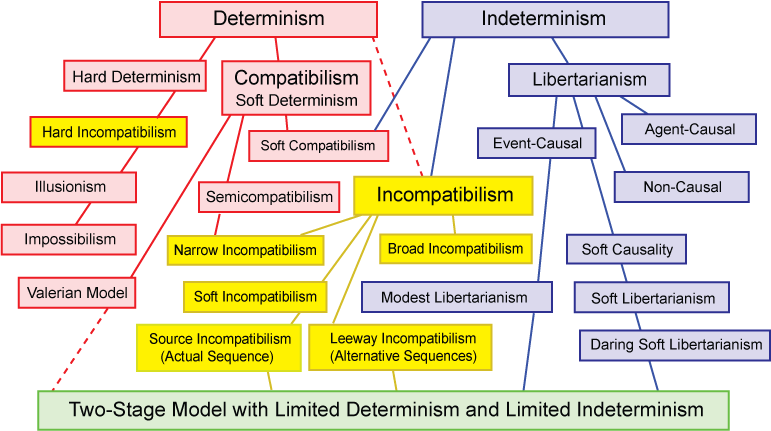
The "family tree" of determinism shows how determinism is not black and white.   


From Bob Doyls aka The Information Philosopher
Illusionism 
llusionism is the position that free will does not exist and is merely an illusion. Many ancient and modern thinkers have made this claim. They have usually been strong determinists, from Hobbes to Einstein. Classical compatibilists, from Hobbes and Hume on, have held that free will exists but that it is compatible with determinism (actually many determinisms).

Since the discovery of irreducible quantum mechanical indeterminism, most scientists and some philosophers have come to understand that determinism is a dogmatic belief unsustainable from the evidence.

It is strict determinism that is the illusion. Quantum mechanics suggests that all physical processes are statistical, and all knowledge is only probabilistic. Hence strict determinism is an illusion

The Valerian Model
Faniel Dennett is a compatibilist and argues for a two-stage model of free will named"Valerian" after the poet Paul Valéry, who was influenced by Poincaré's two-stage approach to problem solving, in which the unconscious generates random combinations. In his book The Psychology of Invention in the Mathematical Mind, Hadamard quoted Valéry...
It takes two to invent anything. The one makes up combinations; the other one chooses, recognizes what is important to him in the mass of things which the former has imparted to him.
Although Valery describes two persons, this is clearly William James's temporal sequence of random chance ("free") followed by a determining choice ("will"). For James, chance and choice are part of a single mind. So perhaps this two-stage mind model is better named "Jamesian" free will.

Dennett makes his version of a two-stage model very clear, defending it with six reasons. However, Dennett remains a compatibilist.


Libertarianism
(Not to be confused with political Libertarianism i.e. the movement promoting individual liberty and minimised government)

Libertarianism says humans are free from all forms of determinism and that freedom seems to require some form of indeterminism. "Radical" libertarians believe that one's actions are not determined by anything prior to a decision, including one's character and values, and one's feelings and desires. This extreme view, held by leading libertarians such as Robert Kane, Peter van Inwagen and their followers, denies that the will has control over actions.

A more modest libertarianism has been proposed by Daniel Dennett and Alfred Mele. They and many other philosophers and scientists have proposed two-stage models of free will that keep indeterminism in the early stages of deliberation, limiting it to creating alternative possibilities for action.

Most libertarians have been mind/body dualists who, following René Descartes, explained human freedom by a separate mind substance that somehow manages to act in the physical world. Some, especially Immanuel Kant, believed that our freedom only existed in a transcendental or noumenal world, leaving the physical world to be completely deterministic.

Religious libertarians say that God has given man a gift of freedom, but at the same time that God's foreknowledge knows everything that man will do.

Incompatibilism

Incompatibilism says determinism is incompatible with human freedom. It is a complex idea, because it is not committed to the truth or falsity of determinism. It was invented by Peter van Inwagen as a new free will position that denies the truth of "compatibilism." It is an "anti-compatibilism" that is more subtle than the question of the existence of free will or determinism.

Hard Incompatibilism

Hard incompatibilists think both free will and moral responsibility are not compatible with determinism.  


5 Do the Laws of Physics Deny Human Freedom?

Of all the determinisms listed above, physical determinism stands out as a special case.

All the fanciful logical, theological, and nomological determinisms described here are basically just ideas.

Isaac Newton’s classical mechanics was also an idea at first, of course, just a theory. But then it was confirmed experimentally, by observations that have grown more and more accurate with every passing decade.

To be sure, the theory has been revised and refined, first for the case of matter moving at velocities that are a significant fraction of the speed of light. Albert Einstein’s special theory of relativity goes beyond classical mechanics, but it asymptotically approaches the classical theory as velocities go to zero.

The next grand refinement was Einsteins general theory, but it too corresponds to ordinary Newtonian physics in the limit.

The most important refinement is the quantum mechanics of Werner Heisenberg and Neils Bohr. Again, it corresponds to the classical theory, in the limit of large numbers of particles.

When Arthur Stanley Eddington revised his 1927 Gifford lectures for publication as The Nature of the Physical World, there he dramatically announced “It is a consequence of the advent of the quantum theory that physics is no longer pledged to a scheme of deterministic law.” There is nothing in the laws of physics, or any wider “laws of nature”, that in any way puts constraints on human freedom.

...and then along came neuroscience...

6 The Evidence from Neuroscience

Any discussion on determinism, especially in the context of free-will,  has to take account of observations of physical phenomena. Experiments show that prior to the conscious intention to perform an action, unconscious brain activity which causes the movement  (the “readiness potential”) is detectable by EEG recordings.  In other words, your brain appears to decide to move before any conscious intention to do so, suggesting that the conscious decision “I choose to move” is an afterthought - not the cause. Things are already set into motion long before any conscious awareness of that decision is made. For more about free will go here